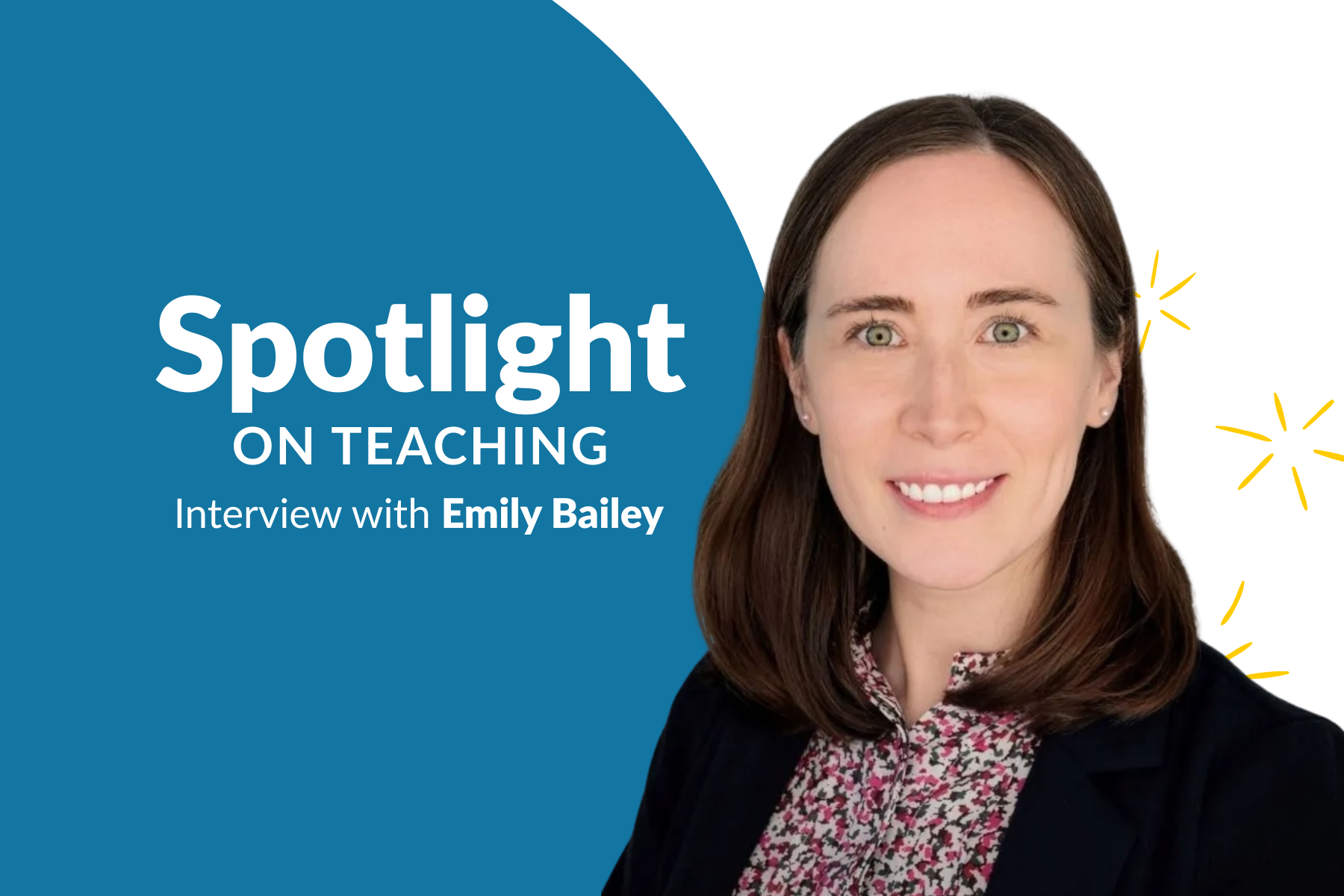
Dr. Emily J. Bailey is the 2026 Katie Geneva Cannon Excellence in Teaching Award Winner. Join us for a pedagogical webinAAR with Dr. Bailey on June 2nd at 2:00pm ET on “Teaching Religion in an Era of AI.”
Emily Bailey is associate professor in the department of philosophy and religious studies at Towson University. As an instructor, Dr. Bailey engages students creatively, often using digital technology that is second nature to them while also taking her students beyond their comfort zones.
Pursuing a Doctor of Education program in instructional technology, Dr. Bailey is committed to improving her teaching. Faculty peers and students praise Dr. Bailey for her inclusion of a variety of teaching and learning models, organization of material, presentation of multiple perspectives and ability to nurture great discussions. She puts learning first, so her students can be better informed, more empathetic members of society.
Dr. Bailey’s community engagement and attention to religious literacy have led to her evolution as an educator, emphasizing her dedication to keeping religion relevant through creative, intentional, and inclusive instructional classroom design.
This interview was conducted by Religious Studies News on March 24, 2026 and edited for publication.
RSN: How would you describe your teaching persona as a professor? How do people perceive you as a teacher?
Emily Bailey: I think that I am a lifelong learner in perhaps the most literal sense, in that I’m still a student. Throughout most of my teaching career, my interest in pedagogy has led to substantial professional development, which I’ve been fortunate to directly apply in my classrooms and teaching practice. It has also allowed me to genuinely be a co-learner with my students. In higher ed we are way past the ‘sage on the stage” era of teaching, which is a good thing, but if students can look up or produce information in a minute, the work that we do in classrooms needs to continue to evolve. I have found that the tone of the classroom changes when students realize that you are figuring out something in the same moment that they are, and that their perspectives are just as valuable as yours or anyone else’s. Being willing to ask questions with students and maintain curiosity are superpowers for any instructor.
“I have found that the tone of the classroom changes when students realize that you are figuring out something in the same moment that they are, and that their perspectives are just as valuable as yours or anyone else’s. Being willing to ask questions with students and maintain curiosity are superpowers for any instructor.”
RSN: Are you currently undergoing or undertaking any specific changes in your teaching or your teaching approach?
Emily Bailey: All of the time. My teaching is competency-focused, but post-pandemic, and with the uptick in generative AI use, this is especially true. In recent semesters, I’ve been thinking about structural changes to all my courses regarding what I want my students to walk away with and then carefully revisiting the pathways for them to get there. This is the place where skills are built and assessed and where I can make sure they are equipped with what I hope they will take away from my courses.
Because I have a strong interest in instructional technology, I continuously work to incorporate tools for engagement and to support varied student needs and interests rather than as novelties or for entertainment. But that requires a lot of planning and a lot of modifications to make sure that students have equal access. I also adapt things as technologies change, so I have a very iterative teaching process from any one semester to the next. There is always something that can be rethought to improve student learning.
RSN: Can you share any particular successful assignments, activities, or exercises you use in your classes that have been highly effective?
Emily Bailey: One of my favorite recent assignments is for my American Religions course. When crafting that syllabus, I wanted to make sure that my students had the opportunity to interact with traditions that we don’t get to cover in some of our other classes. We look at Indigenous communities, the Black church, neopaganism, Santeria, and American-born traditions like the LDS movement and Scientology. We do this in part to explore the true range and lived experience of religion in America, but also to reflect the very diverse students at my institution. When I teach this course, I often have students that identify with or have intersected with many of the traditions that we study. We consider religious identity and belonging across the movements, and then students complete a digital storytelling project to add their own stories into the mix. This is scaffolded from the beginning of the semester, progressing from what might initially feel like a more abstract idea of religious literacy to making contributions to the broader narrative beyond our syllabus.
“Sometimes it takes a little bit of coaching to convince students that their stories matter just as much as any of the narratives that we’ve read or watched together, but the feedback that I’ve received has supported that the project is building their agency as developing scholars and that their stories are boosting the relevance of our course themes about American religion, which has been really exciting.”
Over the course of the semester, students consider how religion in America is experienced, conveyed, preserved, and how people tell their religious stories. Whether a student is a religious practitioner or not, they work to convey how their perspectives either reinforce or shed new light on what we have otherwise learned and then they deliver a multimedia version of their narrative to classmates at the end of the semester. Sometimes it takes a little bit of coaching to convince students that their stories matter just as much as any of the narratives that we’ve read or watched together, but the feedback that I’ve received has supported that the project is building their agency as developing scholars and that their stories are boosting the relevance of our course themes about American religion, which has been really exciting.
RSN: What do you believe has been your most effective tool in reaching students and creating community within the classroom?
Emily Bailey: As an introvert I understand that for many students it’s helpful to have support in overcoming social barriers in the classroom. I intentionally try to cultivate spaces that build a sense of belonging and community from the first day of the semester. I use informal activities in the first two weeks of class to get students talking to each other instead of looking at their phones, giving them simple ice breaker conversation starters. They usually roll their eyes a bit at first, but because there’s some structure to it, the awkwardness quickly goes away, and they get to know each other as people. Then I start to layer in regular partner work, group work, and full class discussions, so that the comfort and the trust in the classroom have some room to grow over time instead of being forced or assumed in some way. Because many of the courses in our program are in the gen ed curriculum and they draw a lot of non-majors who then need to navigate sometimes really contentious conversations about religion or identity or ethics, I’ve found that when students feel at ease with their peers, their conversations are richer, and more honest, and more productive. In classrooms that often include many religious views, it also humanizes our topics. The payoff has been real and measurable. When I have a course evaluation that says that a student made friends when they were learning it tells me that a sense of belonging isn’t just nice-to-have, but a really significant condition for making more rigorous and meaningful academic work possible together in the classroom.
RSN: How are you communicating to students about the importance of learning about religion in 2026? How is this process different than it was 10 years ago?
Emily Bailey: My hope is that students who take my courses will leave with an understanding that religion isn’t a niche interest or something that only matters for devout practitioners because it seems that many of them come into the classroom with those assumptions. Instead, I want them to learn that religion is a force that shapes laws and cultures and relationships and communities in ways that affect everyone. Focusing on religious literacy is one path to recognizing that by engaging with materials that I hope will help students to better understand how people continue to make meaning through religion. Religion is alive and well, and a shaping power in the world today. This matters in the classroom, but it also matters beyond it. I think it is really important for students to understand why moving beyond stereotypes prepares them for the workforce, for life, and hopefully to become the informed, empathetic global citizens that our world needs. It is a responsibility that I take very seriously every semester and one that continues to inspire my teaching practice.
“Religion is alive and well, and a shaping power in the world today. This matters in the classroom, but it also matters beyond it. I think it is really important for students to understand why moving beyond stereotypes prepares them for the workforce, for life, and hopefully to become the informed, empathetic global citizens that our world needs.”
RSN: As the 2026 AAR Teaching Award winner, what do you believe is your major contribution to the profession of teaching?
Emily Bailey: For so many of us in higher ed, teaching is a baptism by fire: we learn through practice, we learn in the classroom, and we often have a sense of what we want students to know and why we want them to know it. Yet, how we get there can be a challenge especially when the “why” feels so critical when we are teaching something like religious literacy. I was at an education conference last summer where they had inspirational quotes about teaching scattered on all the tables, and the one at my seat really resonated with me. It said that the best part of teaching is that it matters, and the hardest part of teaching is that it matters every day. We deeply feel that drive to help students nurture the knowledge and skills that we want them to have, and learning how to close the distance between the “why” and the “how” has been a real game changer for me.
RSN: What advice would you give to instructors who are just beginning their teaching careers? And specifically, if you want to address the academic study of religion, what advice would you give to grad students, professors, and other instructors?
Emily Bailey: First, I would say to try to find ease in making mistakes. It is important to be willing to experiment in teaching and to sit with uncertainty because those are places for real growth as an educator. No course design should survive contact with a new group of students and stay unchanged. I’ve found that the semesters when I was the most willing to try something new, or poll my students about what was working, or modify an assignment that was not landing quite where I wanted it to, were often the most interesting and productive ones. Teaching is not a static practice, and our students are always changing, so approaching every semester with an open mind rather than a fixed script is something that I would encourage any new teacher to embrace.
“Teaching is not a static practice, and our students are always changing, so approaching every semester with an open mind rather than a fixed script is something that I would encourage any new teacher to embrace.”
Second, to learn from your colleagues and from your students. My colleagues and my students have been among my greatest teachers, and building in regular opportunities to hear from them has helped to shape my practice in ways that no professional development alone could ever do. I would encourage new teachers to embrace opportunities to stay curious. To remain a learner when they become a teacher because there are opportunities for all of us to learn all the time. In a dynamic field and academy, I think that this willingness to grow and the creativity that can stem from it will be critical for the future of the study of religion.
This interview is part of our Spotlight on Teaching series.
News Source