
RSN Podcast
Androgynes and Eunuchs in Rabbinic Literature with Max K. Strassfeld
- Home
- Religion Studies News
- RSN Podcasts
- Androgynes and Eunuchs in Rabbinic Literature with Max K. Strassfeld
Max K. Strassfeld, associate professor of religion at the University of Southern California and winner of the 2023 AAR Book Award for Excellence in the Study of Religion: Textual Studies, speaks to Kristian Petersen about their book, Trans Talmud: Androgynes and Eunuchs in Rabbinic Literature (University of California Press, 2023).
Guests
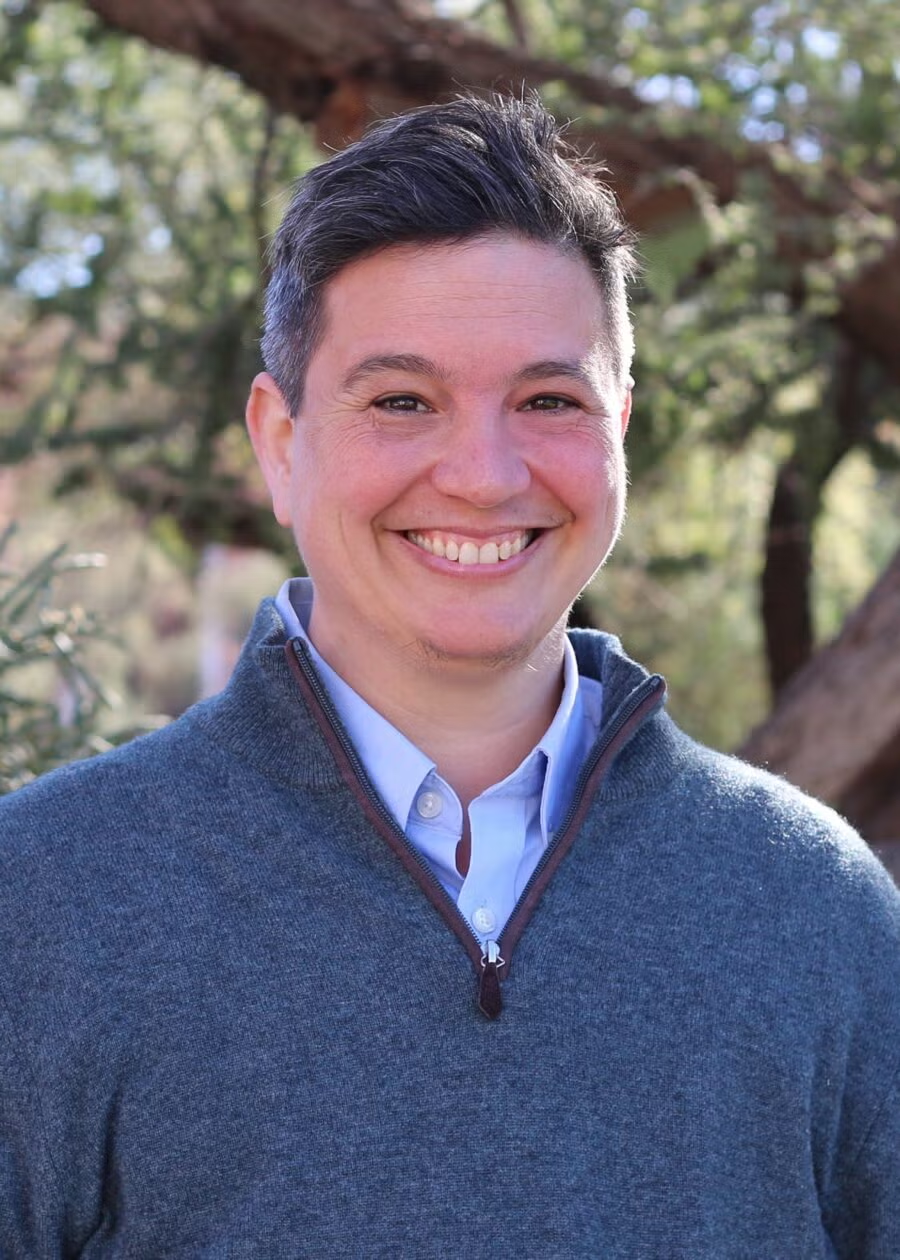
Max K. Strassfeld
Kristian Petersen:
Welcome to Religious Studies News. I’m your host, Kristian Petersen, and today I am here with Max Strassfeld, associate professor of religious studies at the University of Southern California and winner of the 2023 AAR Book Award for Exellence in the Study of Religion: Textual Studies. They are here to speak to us about their book, Trans Talmud: Androgynes and Eunuchs in Rabbinic Literature, published with the University of California Press. Congratulations Max, and thanks for joining.
Max K. Strassfeld:
Thank you so much for the invitation to come discuss my work.
Kristian Petersen:
Yeah, it’s a really interesting book. I’m glad it won the award and I got to take a look at it and I’m excited to talk about it here. As the title suggests, you examine the subject of eunuchs and androgynes in the Talmud. Some of these terms might not be familiar to everybody, so perhaps you can help us think through those, but also tell us perhaps where this intersection of subject matter became of interest to you. Why did you decide to tackle this subject?
Max K. Strassfeld:
Okay, great. So when we’re talking about the Talmud — I’ll just do a little overview of Talmud, eunuchs, androgynes and what the rabbis mean, and then I’ll come to your question about how I came to this topic — when we’re talking about the Talmud, we’re talking about one composition that’s found in a broader body of literature called rabbinic literature. And rabbinic literature originates in the first six centuries of the common era. It’s a body of literature, a product of a movement called the rabbinic movement, which is spread between Roman Palestine to the west and the Sasanian empire to the east. I’m oversimplifying a little bit, but that’s the kind of broad when and where we are.
My book studies eunuchs and androgynes within that literature, but what the rabbis mean by eunuchs and androgynes is much more expansive than what we tend to mean by those terms in English. So I’ll just give a little overview. I think it’s helpful to get a sense of the different kinds of bodies the rabbis are discussing. You don’t have to — I won’t go through all the Hebrew terms — but just to give a broad impression.
So for the rabbis, there are different types of eunuchs. There’s the eunuchs who were thought to be male at birth, and those eunuchs undergo changes to their body and their genitalia later in life. And that’s what we tend to associate with that English word eunuch. There’s also, for the rabbis, men and women who are born with bodily differences that mean that they’re not going to be able to procreate. And those men and women who are born with different bodies are also called eunuchs for the rabbis. So, first of all, their conception of what these categories include is much broader than what that English term includes.
There’s also figures that I am calling androgynes in English. One of them is described in the early sources as having the ability to menstruate and have seminal emissions. So from there, scholars think that this is a person who has two sets of genitalia and the other is a tumtum, and there’s just really no good translation for tumtum, but basically the rabbis are not sure what the sex gender of the tumtum is.
So when I’m talking about eunuchs and androgynes in rabbinic literature, it’s shorthand for a number of different categories that don’t really match our English terms or the way we conceptualize sex and gender terribly neatly. And I also want to just note that none of these categories precisely match what we would think of as either intersex or transgender, how we would define those contemporary terms.
So — I came to studying these texts, I came back to graduate school basically to write this book. I was interested in these sources. I was studying with my havruta, my study partner, who was my father, and we came across these categories and I just felt like there was a whole world of sex gender in these sources that weren’t part of my traditional education — the way I was brought up to study these texts in a traditional Jewish school — but that were really compelling to me as a trans and queer person and were in some ways part of my inheritance. And so for me to be able to really pick apart the sex gender dynamics in the way that I wanted to meant going back to graduate school. So I went back with a certain set of texts in mind that I wanted to study that I knew I wanted to write a book about.
Kristian Petersen:
That’s great. One of the main claims of the book, if I’m reading correctly, is that these folks have largely been excluded in thinking about gender in rabbinic literature. And part of what you do with the project is you recenter these folks in thinking about questions of sex and gender in the past. You offer a kind of specific type of reading which you call “transing” as a method. So I’m wondering, I guess, a two part question of why is it important to recenter non-binary folks in this study of sex and gender in the past, and how does this approach that you offer help us? Why is it productive, in your analysis?
Max K. Strassfeld:
Great question. I think if you look at the way that eunuchs had been studied in the past, because there have been some texts, some scholarship that had looked at eunuchs and rabbinic literature before — I’m not talking the work of Sarra Lev, or Charlotte Fonrobert, or Gwynn Kessler, the more recent stuff — but it’s either very pathologizing, that older scholarship — so talking about using language like aberration, for example, to describe these categories or deviation — or it’s really treating eunuchs as a backdrop to look at the kinds of categories they’re more interested in, like sexuality.
So we often see a kind of treatment of eunuchs, for example, as a kind of conceptual backdrop against which a same sex sexuality becomes less pathological, if that makes sense. And so what happens when you stop treating eunuchs as the kind of source material against which to compare the thing that you’re actually interested in is that a very different picture of sex and gender emerges, one which is much more complex about the relationship of sex gender altogether in the past. Do we even have these taxonomies? What do our categories, not just of eunuchs and androgynes, but of a men and women, male and female, look like when we examine the broader taxonomy that the rabbis are actually working with?
So part of what I’m doing when I’m thinking about centering these categories is how does the story we are telling about gender and sexuality in rabbinic literature change if we take these eunuchs and androgynes not as outliers, not as the kind of aberrant figures against which to compare men and women or to talk about sexuality, but if they are part of the taxonomy of sex gender, what happens to how we think about sex and gender in Jewish law?
Transing as a term, as a verb, which is playing with that prefix “trans” from transgender, is originally proposed by Susan Stryker, Paisley Currah, and Lisa Jean Moore in Women’s Studies Quarterly, so I don’t make it up, but one of the ways I’m using transing is to think about how certain kinds of bodies are made to carry the weight of failure.
For example, anyone who’s struggled to have a child will tell you that reproduction, even when you have all the necessary components, is not guaranteed. And when we talk about failures in reproduction and rabbinic literature, there’s a general acknowledgement that not everybody can procreate, that it’s a fraught enterprise, it can fail. We have all sorts of stories, for example, in the Hebrew Bible — which is an earlier text than rabbinic literature, that the rabbis inherit — that talk about infertility. So when I think about eunuchs which are characterized, for the rabbis, by their inability to procreate, I step back to ask a very naive question: if everyone can fail to procreate, if everyone can be born with bodies that have differences that mean that reproduction will be difficult or maybe even impossible — why is it that the failures of eunuchs are unique or pathological?
And asking those kinds of naive questions can sometimes be quite helpful to point out the underlying logics of the sources. So I argue in the book, in some places, using this framework of transing, that the rabbis are singling out eunuchs and androgynes, subjecting them to levels of more scrutiny to their bodies, and in some ways displacing fragilities that are true of all of us. All of us can fail to procreate. They’re displacing those onto eunuchs and androgynes in those moments. And that’s one of the things I mean by transing. And it’s one of the questions that I carry throughout the book: whose bodies are made to bear the weight of particular kinds of failures?
Kristian Petersen:
In one chapter, you consider androgynes within legal context, and I’m wondering if you could tell us how interpreters tried to make sense of hybrid gender through existing frameworks and categories, and then how that might be relevant for questions and legal debates today, which you bring in that chapter too.
Max K. Strassfeld:
Yeah, so there is a kind of piece about the context for me, which is that I wrote this book entirely within the first Trump presidency where we saw the ramping up of anti-trans rhetoric, which has only gotten worse now, particularly in the recent accusations we’ve seen in the last couple of years of grooming. So the context in which I wrote this book is this really anti-trans moment. And part of what I’m trying to work out in the book is what it means for me as someone who is a trans Jew, a trans scholar, to be writing a book about androgynes and eunuchs in this moment in the US, and how might I have to write that book differently in order to acknowledge the kind of context in which I’m writing?
One of the chapters weaves together, very anachronistically, very deliberately, an analysis of androgynes, specifically in rabbinic law, in early rabbinic sources, with an analysis of us anti-trans law. I read closely the texts of both of those sources and one of the things I’m arguing is that if we understand that text in rabbinic literature as kind of central to the project, not an outlier, but if androgynes are central to the project of imagining gender, then what we’re seeing is a kind of broader ontological meditation on gender and how it works in Jewish law. And the Androgynes are the way that the rabbis are working that out. So the text is asking: how is the androgyne like a man? How is the androgyne like a woman? How is the androgyne like both, and how is the androgyne like neither? And then it sort of goes through and lists which laws pertain to the androgyne in all of these ways. But this is one of the only places where we see the rabbis making a kind of systematic map of law in relation to the category of gender. And the androgyne is central, then, to that project of imagining what gender is, what it does, how it regulates different bodies, et cetera.
Contemporary anti-trans law is working within a totally different framework. It has a different definition understanding of transgender. I don’t think the androgyne is exactly equal to a transgender person. And we’re talking about very different cultures, very different conceptions of what law means. The rabbis mean something quite different when they use the word halakhah, which is sort of badly translated into English often as “law.” So in all sorts of ways, these are completely different texts, completely not comparable. However, what is really interesting and is a point of connection between the two, besides me, besides the fact that I’m living in this society where I am both studying these sources and I’m being regulated by these laws, is that they’re both attempts to think through and consider ontologies of gender. How gender is in the world, what gender means, how people enact gender, what is permissible, what is not? They’re ways of regulating gender.
So in that way, I look at two very different understandings of gender, two very different attempts to regulate gender, both of which are pointing to some biblical texts, I think, both of which are referring back to the Hebrew Bible, some verses in Genesis, and have very different understandings of those verses. I’m looking at a reception history of some of these texts that are now being thought to say that binary gender is the norm and should be the norm, that are being claimed within US law to say that binary gender is the norm. And I’m looking at rabbinic interpretations of those that are quite different from those contemporary interpretations of those verses.
Kristian Petersen:
In a later chapter, you explore rabbinic debates about masculinity more precisely. So can you tell us the factors that informed how rabbis classified masculinity? How did bodies and genitalia line up with notions of procreation, for example, or gender expectations? And then you also bring in questions of disability and how that might complicate these interpretations. Can you tell us about those kind of conversation?
Max K. Strassfeld:
Yeah. So there are these sources in the literature that talk about bodily “damage,” and I’m using damage there with some scare quotes because I think that they’re thinking of these bodies as damaged — that doesn’t mean that we have to accept their understanding, but within the context of how they’re talking about masculine bodies, they think of it as damaged. So the rabbis are looking at these verses in the Hebrew Bible that talk about priestly bodies and the ways in which priestly bodies are supposed to be “whole” — and again, you can think of whole in scare quotes. They’re trying to figure out what that means for different kinds of genital difference, right? So what are the ways in which genital difference can be inborn or natural or, in their case, in the rabbinic case, because they’re working with a theological frame, God-given, and what are the ways in which genital changes can be damage to the body and therefore should be regulated under these questions of what the priest can or can’t do with a damaged body?
And it’s a really interesting discussion about masculinity. It’s a really interesting way that they’re trying to work out the rights of the masculine householder, who he can marry and who he can’t, what restrictions apply based on this genital damage. And part of what I’m arguing there is, yes, there’s a formal relationship to the Bible, there’s a reason the rabbis are talking about these verses, they’re inheriting the debate to a certain extent, but they’re also using this rhetorically to imagine what is the masculine body and what rights accrue to that masculine body, and — always in relation to women — which woman can he acquire in marriage? It’s a very androcentric marriage system in that sense. Eunuchs basically become a way to imagine the perfection of the masculine body in those texts and to think about that question of: some people are born with bodily differences, some people obtain them; should those be treated differently because of the theological question of being created by God?
Kristian Petersen:
Obviously there’s a lot more to the book that we are not going to be able to tackle here. I did want to just ask you as a kind of a final question, how you think others in the study of religion might take up your work and move on from here? Perhaps in your conclusions or perhaps employing your methods, what do you think others in the study of religion might do with your work?
Max K. Strassfeld:
Yeah, thank you. So scholars that are thinking about the study of gender, sex, and sexuality in a pre-modern context might find this book helpful. I’m working through what it means to study eunuchs and androgynes in a culture where there’s not a neat division between sex and gender and the categories are so different that they bear little resemblance to modern taxonomies. So what does it even mean to use the word gender when studying these sources in the past? When masculinity, for example, has as much to do with priestly status and damage? Those are not things that we tend to think of being related to masculinity or gender today. So what does it mean when we’re talking about gender in a completely different framework and trying to think about that dilemma from a trans studies perspective?
But I also think a lot of us study sources and traditions that are being marshaled towards conservative ends right now. And for scholars struggling with those dynamics, my book can function as a kind of case study. I wrote the book asking myself, what does it mean to be trans and studying eunuchs and androgynes in Jewish late antiquity in such an anti-trans political moment? And I try to address those dynamics through a series of experiments. One — the chapter you just asked me about — weaving together ancient texts with anti-trans law; one chapter has a short story, and I collaborate with a Jewish trans artist; and each is really an attempt to grapple with the basic question about what it means to write this book in this political environment. And I think I’m not the only scholar struggling with these questions right now.
Kristian Petersen:
Certainly. And yes, I think that’s a great tool that a lot of scholars within the study of religion will need. So thank you for writing the book. Thank you for sharing your thoughts on it now, and congratulations again on the award.
Max K. Strassfeld:
Thank you so much, and thank you for your engagement with my work, that was generous of you.
News Source

Publish Date
October 16, 2025
Related Podcasts
RSN Podcast
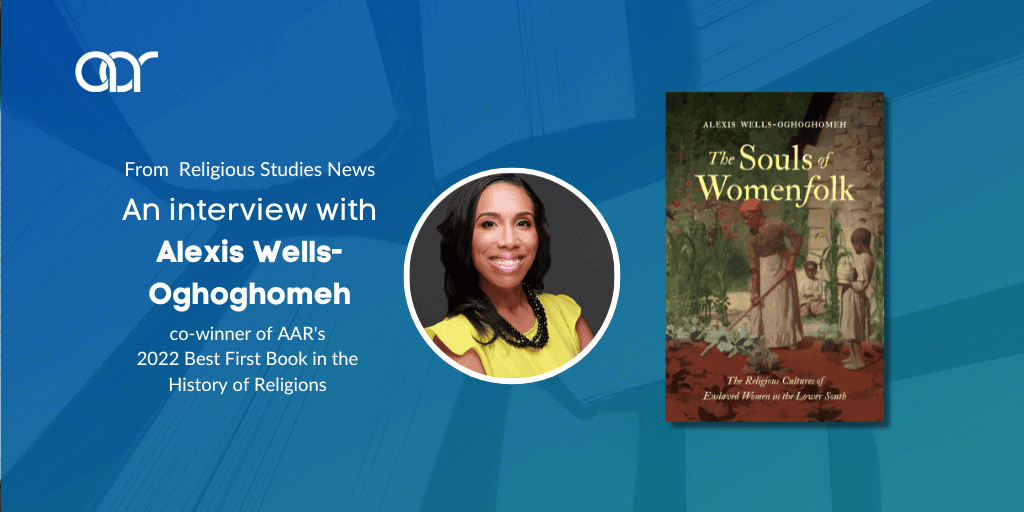
Religious Cultures of Enslaved Women in the Lower South with Alexis Wells-Oghoghomeh
Alexis Wells-Oghoghomeh, assistant professor of religious studies at Stanford University and co-winner of AAR’s 2022 Best First Book in the History of Religions Award discusses her book The Souls of Women Folk: The Religious Cultures of Enslaved Women in the Lower South.
RSN Podcast
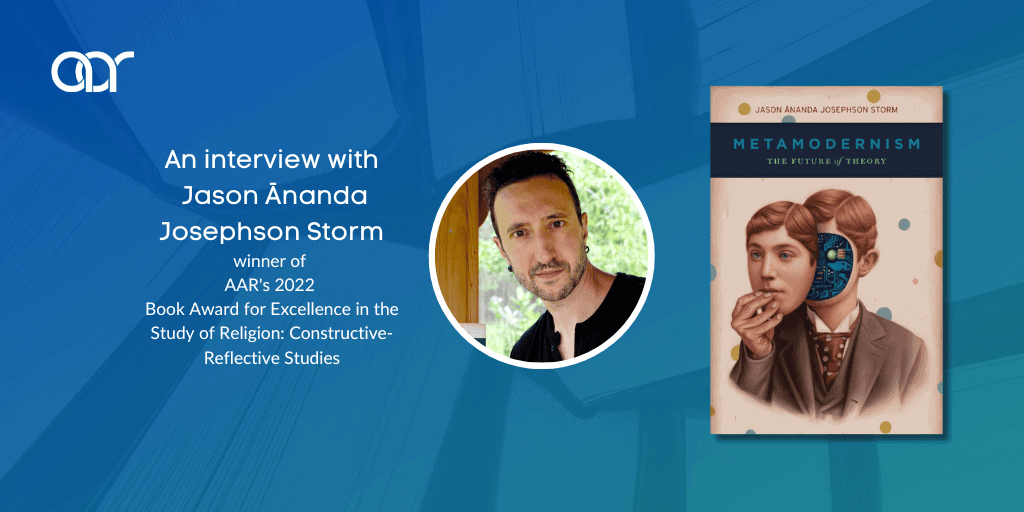
Metamodernism and the Future of Theory with Jason Ānanda Josephson Storm
Jason Ānanda Josephson Storm, professor of religion and Chair of Science and Technology Studies at Williams College, discusses his book Metamodernism: The Future of Theory which won the 2022 AAR Book Award for Excellence in the Study of Religion: Constructive-Reflective Studies.

RSN Podcast
Art as Embodied Experience with Kathryn R. Barush
Kathryn R. Barush joins Kristian Petersen to discuss her award-winning book Imaging Pilgrimage: Art as Embodied Experience which expands the concepts of “pilgrimage” and art as lived experience.