

Please join us in celebrating our members on their professional news and accomplishments!
As a reminder, AAR publishes member accomplishments including new publications, award announcements, and media mentions. Share your wins with us!
Books and Publications
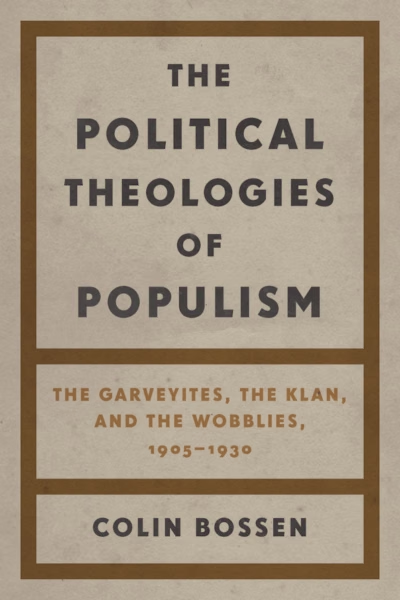 Colin Bossen
The Political Theologies of Populism: The Garveyites, the Klan, and the Wobblies, 1905–1930
In this work, author Colin Bossen argues that for over a century, American populist movements—even explicitly secular ones—have drawn on religious ideas and practices to infuse their politics and bring people together. Bossen explores Pan-African populism, white supremacist populism, and early twentieth-century pluralistic populism in the United States that coalesced into well-known, vastly different groups with a lasting presence in the American imagination: the Universal Negro Improvement Association (also known as the Garveyites), the Ku Klux Klan, and the Industrial Workers of the World (also known as the Wobblies). This book employs both historical analysis and political theory to unpack the trajectory of these groups and to illustrate how their respective search for belonging showcases as similar principles, despite their extremely different beliefs. This is a finding that, Bossen argues, exemplifies the mechanisms behind twenty-first-century politics, including the rise of Trumpism. This groundbreaking comparative analysis challenges readers to consider the repetition of history in today’s political landscape and shows them how to rise to the challenges of our current political moment.
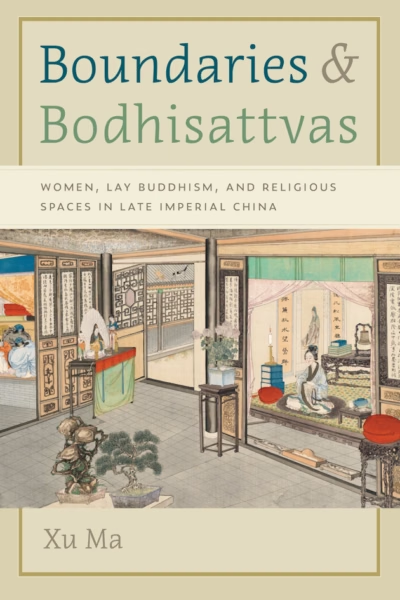 Xu Ma
Xu Ma
Boundaries and Bodhisattvas: Women, Lay Buddhism, and Religious Spaces in Late Imperial China
From the sixteenth to early nineteenth centuries, Neo-Confucian ideology sought to reinforce the seclusion of women within the domestic sphere, while flourishing lay Buddhism increasingly fueled their passion for visiting temples and going on distant pilgrimages. Xu Ma explores this cultural tension to reveal how religious spaces—physical, imagined, and embodied—emerged as a “third social space” that both sustained and subverted the Confucian binaries of inside and outside, public and private.
Drawing on an impressive range of sources, from popular fiction and drama to biographical accounts and archaeological evidence, Ma shows how women’s religious engagement was simultaneously celebrated and condemned in literary and cultural imagination. Outdoor temples were sites of controversy, where women were portrayed as both vulnerable to corruption yet also capable of transcendent manipulation. Through domestic altars and household shrines, women redefined marital and gendered dynamics on their own terms. Eventually, even the female body itself became a sacred site of meaning.
This richly interdisciplinary study redefines the place of women in Chinese religious and cultural history. By blending gender studies, spatial theory, and literary analysis, Boundaries and Bodhisattvas demonstrates how women’s bodies and hearts reconfigured both Confucian gender paradigms and the broader religious landscape of late imperial China. It is essential reading for anyone interested in the intersections of gender, religion, and cultural narratives.
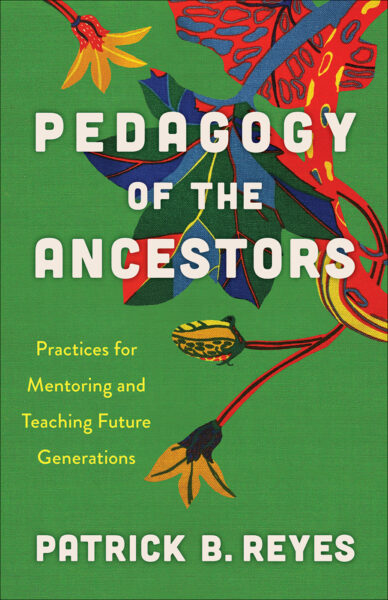 Patrick Reyes
Pedagogy of the Ancestors: Practices for Mentoring and Teaching Future Generations
Ancestors embody the past, and they also offer spiritual guidance and friendship to those coming of age. We see this across cultures and religious traditions. Communities rely on ancestral wisdom to educate and nurture future generations, but oppressive systems severe these roots. In Pedagogy of the Ancestors, Patrick Reyes explores the transformative roles of ancestors, as living memories and semidivine beings, in guiding and teaching younger generations.
Readers are invited to rethink education as rooted in our relationships with those who came before and those who will come after. Reyes calls on educators, caregivers, religious leaders, pastors, and mentors to teach and live as the ancestors our descendants deserve. Pedagogy of the Ancestors shares educational practices for those creating spaces of belonging and accountability, providing guidance on the skills and perspectives needed to mentor young people effectively. Through storytelling, rituals, and grounded exercises, readers are invited to reflect on their lineages, recognizing the gifts and traumas they inherit so that they may pass on hope and healing to the next generation.
Drawing on Indigenous wisdom, spiritual traditions, and Reyes’s experience as a scholar and pastor, Pedagogy of the Ancestors reframes education and mentorship as relational, future-oriented work. It emphasizes forming character, cultivating joy, and creating spaces where young people can flourish.