

It is no secret that religion departments have faced serious difficulties in recent years, but a new report from the American Academy of Arts and Sciences—based on a national survey of department chairs in 14 humanities disciplines—highlight some of the challenges religion departments are facing but also show how departments are responding. Since this study focused on humanities disciplines, the survey was administered to departments that focused broadly on religious studies and excluded departments with an explicitly vocational orientation (e.g., theology and pastoral studies).
As of fall 2023 there were approximately 482 departments awarding degrees in religion, with 184 at primarily undergraduate institutions, 125 at master’s institutions, and 173 at primarily research institutions. But this represents a significant decline from an earlier survey (in 2017). Among the disciplines in the survey, religion had the largest decline in the number of departments awarding degrees (a 17% drop).
Among the remaining departments, however, about 61% of department chairs reported that they felt optimistic about the future of the discipline at their institution, with only 23% feeling pessimistic. That level of optimism was notably higher than that found in other disciplines such as English and history.
The remaining departments employed a total of approximately 4,390 full- and part-time faculty members in fall 2023 with an average of 9 per department and a median of 8. The gap between the average and the median for this statistic and others in the survey—though smaller here than for some of the other disciplines—demonstrates how a few large institutions can skew the averages. For example, the average number of faculty per department at primarily undergraduate institutions was just 5.1, compared to 14.4 at primarily research institutions.
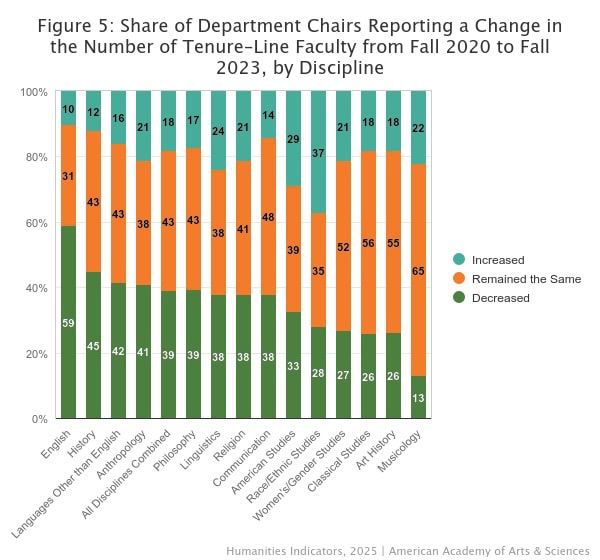
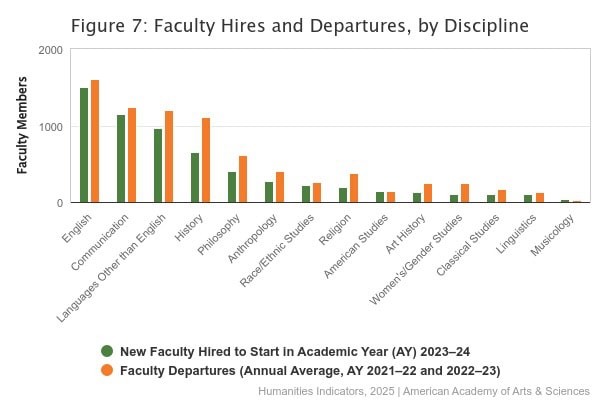
While religion had a relatively small share of department chairs who reported feeling pessimistic about the future, the discipline joined art history, history, and classical studies in seeing a noticeable decline in the share of their faculty on the tenure-track. 32% of religion departments made at least one new hire for the 2023–24, resulting in 200 new permanent faculty, but had lost an average of 380 faculty per year over the last two years. This is in contrast to the previous surveys, where the number of faculty hired was typically larger than the average number of faculty departures. However, the overall balance between tenure-line and full- and part-time adjunct faculty did not change significantly for religion departments. But this was due to an unusual situation where the proportions of tenured and full-time nontenure-track faculty increased, while the proportions of tenure-track and part-time nontenure-track faculty members decreased—effectively balancing the gains and losses in the two categories.
The survey also offered additional evidence that the overall contraction in faculty is likely to continue. Asked about the future, just 11% of chairs expected that the number of tenure-track faculty in their departments would increase over the next three academic years, while 35% thought the number would shrink—one of the largest shares among the disciplines in the survey. In comparison, 22% of department chairs believed the number of religion faculty employed off the tenure track would increase, while 18% thought that number would decrease.
Despite recent declines in the number of faculty, religion departments still taught a substantial number of students, both at the undergraduate and graduate levels. In fall 2023, religion departments had total enrollment of 217,050 in undergraduate courses, with an average of 450 per department, and median of 305. (Students who took more than one course were counted in each course they took, so the actual number of students taught was somewhat smaller.) And looking at recent enrollment trends, religion departments had one of the smallest shares of chairs reporting a recent decrease in undergraduate enrollment (24%), while 35% of the departments (primarily at research universities) reported enrollments had increased.
For the 2022–23 academic year, religion departments awarded an average of five bachelor’s degrees per department, and an average of 15 juniors or seniors with a declared major in the subject with a median of 10. A positive indicator of future growth in the discipline would be a greater than 2 to 1 ratio of juniors and seniors with a declared major to the number of bachelor’s degrees awarded. Religion was one of just six disciplines in the survey to meet this benchmark (with the others being art history, history, classical studies, English, and anthropology).
Most departments in the survey reported engaging in one or more recruitment strategies to increase the number of majors in their disciplines, but religion departments stood out because their most popular strategy was outreach to community colleges (reported by 77% of the departments). Religion was the only discipline in the survey that made this strategy such a significant priority. Another recent Humanities Indicators research paper highlights the importance of this kind of outreach, noting that students entering a four-year program with an associate’s degree were substantially more likely to declare a major in the humanities. Unfortunately, the survey could not correlate specific strategies to successful recruitment, but the numbers above indicate that religion departments have been more successful than some of the other humanities disciplines in attracting students in recent years. The second most common strategy used by religion departments was outreach to students in other majors or who were undeclared.
The Humanities Department Survey is also the only source of information on the number of minors, certificates, and other microcredentials awarded nationally in humanities disciplines. About half of religion departments awarded minors in the 2022–23 academic year. In the same period, only 13% awarded certificates or other microcredentials, which was one of the smallest shares among all the disciplines in the survey. Religion departments awarded an average of eight minors and a median of six for the 2022–23 academic year. This median puts religion on the lower end of all the disciplines in awarding minors, alongside art history.
At the graduate level, degree-granting religion departments had 7,270 enrollments in graduate courses in the fall of 2023, with 3,530 students working towards graduate degrees. 320 of those students were new doctoral students in the field, who were admitted to their programs at the 73 departments awarding PhDs in the fall of 2023.
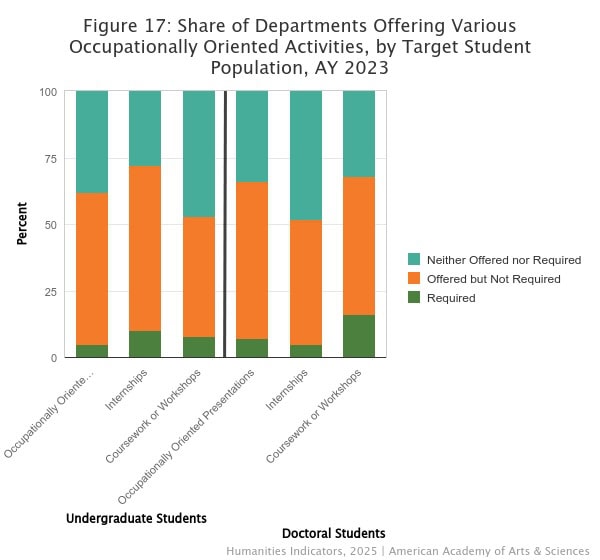
The survey also asked what departments were doing to help both their undergraduate and graduate students prepare for future careers. While 61% of departments offered or required internships for their undergraduates, only 41% offered or required occupationally-oriented coursework or workshops for them. For those departments offering doctorates, 76% at least offered occupationally-oriented coursework or workshops with 41% of departments requiring this of their PhD students. 65% of departments offered occupationally-oriented lectures, but only 6% required this activity. Despite these efforts to support them on their career paths, the survey found that only 41% of religion departments tracked graduate student career outcomes.
The survey also asked whether department chairs had concerns about potential threats to the academic freedom of their faculty members, and found 23% were troubled—close to the average for the disciplines included in the survey (and with the added caveat that this was administered before the recent national election). Diving deeper, 66% of chairs with a concern were worried about threats to such freedom from the academic administration of their institutions. The second most common concerns were the threat posed by federal and state governments and the student body (both 45%).
One of the goals of the Humanities Department Survey is to provide useful data for individual departments and institutional administrators as they think about future goals for their disciplines. Information from the results of this survey can be useful to those in the academic study of religion working at all levels of academia to make the case for funding, scholarship programs, or additional recruitment efforts aimed at bringing students into the discipline. A more detailed profile, including comprehensive data tables, for religion departments can be found on the website accompanying the full report. The Humanities Indicators team also welcomes questions about the findings from this round of the department survey as well as suggestions for future research.
News Source

Author(s)

Sara Mohr
Carl and Lily Pforzheimer Humanities Policy Fellow at the American Academy of Arts and Sciences