Native American Heritage Month Reading List
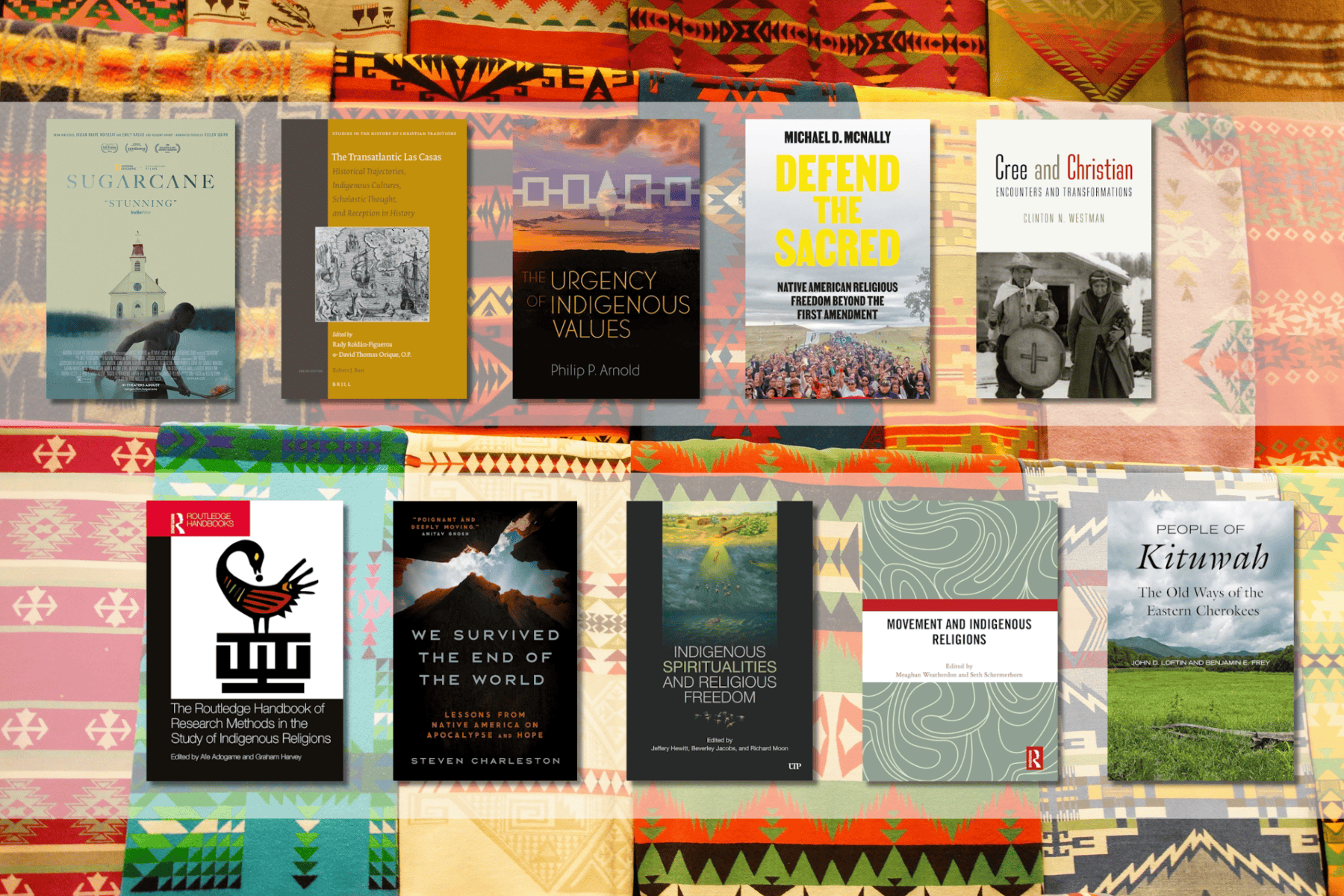
Some Suggested Titles from AAR's Reading Religion
Reading Religion is an openly accessible book review website published by the American Academy of Religion. The site provides up-to-date coverage of scholarly publishing in religious studies, reviewed by scholars with special interest and/or expertise in the relevant subfields. Reviews aim to be concise, comprehensive, and timely.
Below, the editors of Reading Religion have selected some books and reviews from the site and have shared some titles available to review. If you’re interested in reviewing books for Reading Religion, take a look at the guidelines. If there are any books missing from the Reading Religion site that you think should be there, email readingreligion@aarweb.org.
Reviews to Read
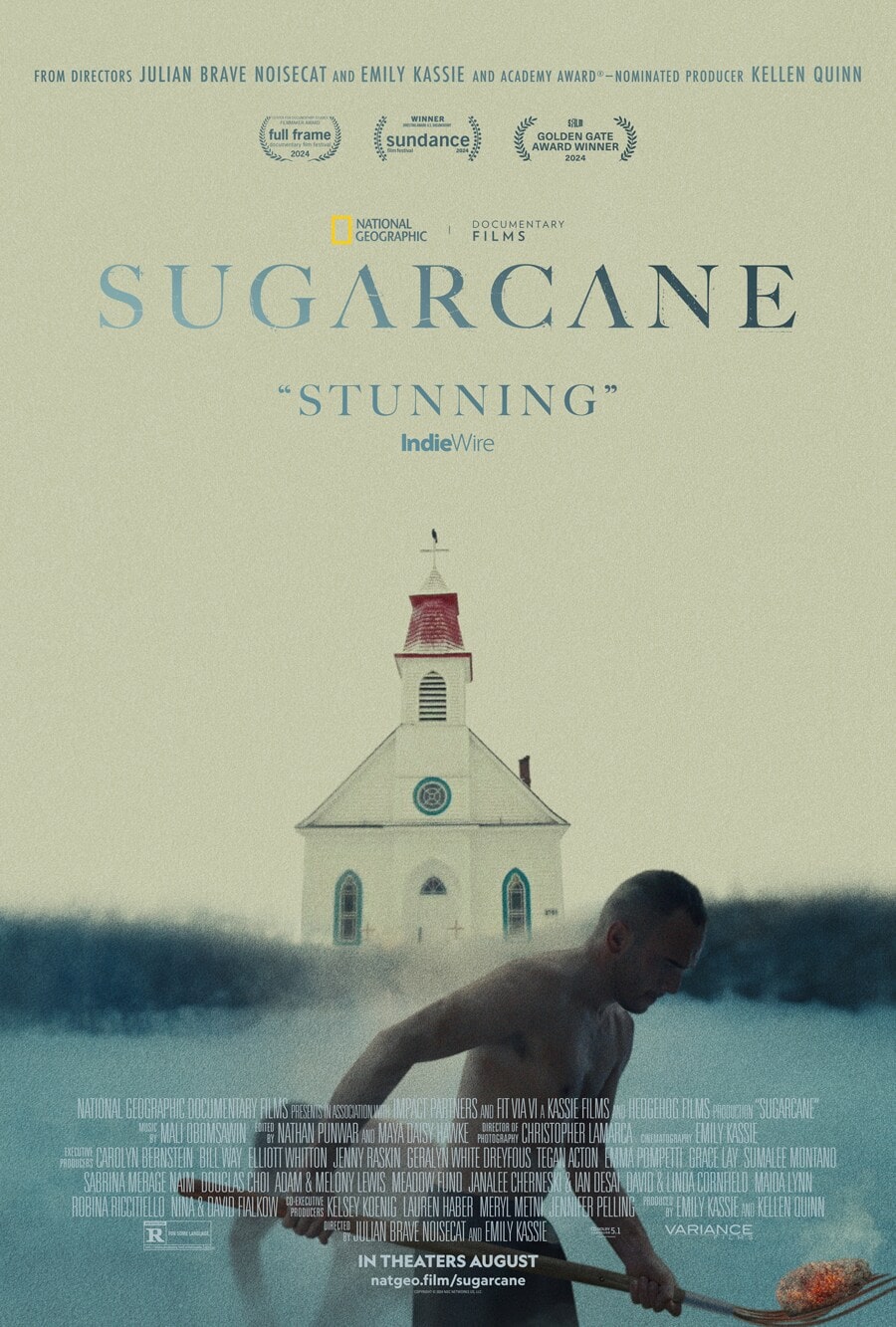
Sugarcane
Directed by Julian Brave NoiseCat and Emily Kassie; produced by Emily Kassie and Kellen Quinn
From the review:
“Sugarcane is masterful in its ability to entertain multiple truths and possibilities at once. Whereas boarding school apologists (disguised as film “critics”) have tried to dismiss it as “shock-u-mentary,” the documentary is careful and restrained, allowing elders to tell their stories—verbally, visually, and otherwise. The film’s brilliance is rooted in the directors’ relational approach, one that centers communal engagement, cultural sensitivity, and Indigenous futurity, resonating with the methodologies of Native American Indigenous Studies (NAIS)." — Zara Surratt
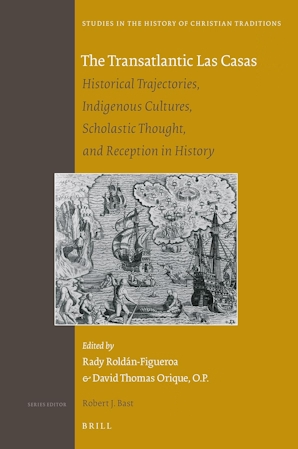
The Transatlantic Las Casas:
Historical Trajectories, Indigenous Cultures, Scholastic Thought, and Reception in History
By Rady Roldán-Figueroa and David T. Orique, O.P.
From the review:
“[This book] is a great contribution to the history of colonialism and the complex narratives of those involved. This is a volume that achieves its goals: to move beyond the Brevísima, present a less Eurocentric view, and promote Lascasian studies to generate debate and genuine disagreement.” — Josefrayn Sánchez-Perry
The Urgency of Indigenous Values
By Philip P. Arnold
From the review:
“[This] is an excellent book that continues conversation and dialogue with Indigenous Peoples. It also advances Indigenous values: to care for our living natural world and to care for one another, as we—human and nonhuman—live together on this Earth as cohabitants.” — Louis Kunāne Hillen
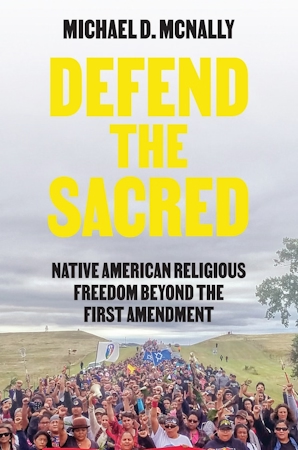
Defend the Sacred: Native American Religious Freedom beyond the First Amendment
By Michael D. McNally
From the review:
“McNally’s scholarship on Native American legal contestations is beneficial to any scholar of religion or law. Indeed, his work is likely the most comprehensive on Native American religions and law to date.” – James W. Waters
Available for Review
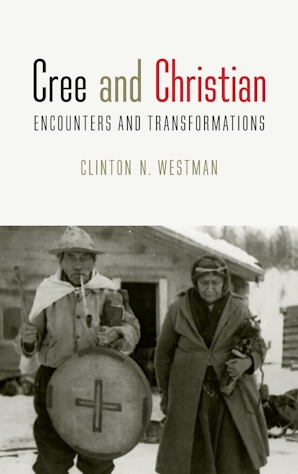
Cree and Christian:
Encounters and Transformations
By Clinton N. Westman
From the publisher:
“Cree and Christian develops and applies new ethnographic approaches for understanding the reception and indigenization of Christianity, particularly through an examination of Pentecostalism in northern Alberta. Clinton N. Westman draws on historical records and his own long-term ethnographic research in Cree communities to explore questions of historical change, cultural continuity, linguistic practices in ritual, and the degree to which Indigenous identity is implicated by Pentecostal commitments. Such complexity calls for constant negotiation and improvisation, key elements of Pentecostal worship and speech strategies that have been compared to jazz modes.”
The Routledge Handbook of Research Methods in the Study of Indigenous Religions
Edited by Afe Adogame and Graham Harvey
From the publisher:
“Exciting developments in research among, with and by Indigenous scholars and communities are enriching a wide range of disciplines, methodologies and trans-disciplinary conversations. This growing field offers important insights and provocations about methods and approaches. Key issues such as relationality, decolonisation, research ethics, pedagogy and collaboration necessarily require improvements both in scholarly description and in scholarly practice. Similarly, critical themes for Indigenous people intersect strongly both with recent scholarly “turns”, such as embodiment, gender, performance, place, ontology, and materiality. The Routledge Handbook of Research Methods in the Study of Indigenous Religions reflects on appropriate approaches and methods with over 28 chapters by a team of international contributors. . . . The Routledge Handbook of Research Methods in the Study of Indigenous Religions is essential reading for students and researchers in religious studies and Indigenous studies, and the handbook will also be very useful for those in related fields such as sociology, anthropology, history and politics.”
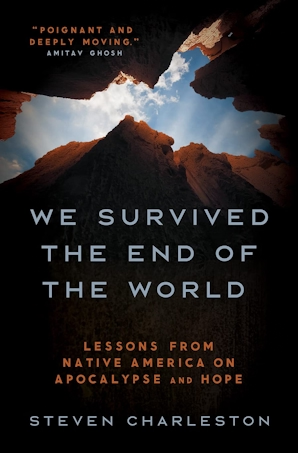
We Survived the End of the World: Lessons from Native America on Apocalypse and Hope
By Steven Charleston
From the publisher:
“From the moment European settlers reached these shores, the American apocalypse began. But Native Americans did not vanish. Apocalypse did not fully destroy them, and it doesn't have to destroy us.
Pandemics and war, social turmoil and corrupt governments, natural disasters and environmental collapse--it's hard not to watch the signs of the times and feel afraid. But we can journey through that fear to find hope. With the warnings of a prophet and the lively voice of a storyteller, Choctaw elder and author of Ladder to the Light Steven Charleston speaks to all who sense apocalyptic dread rising around and within. . . .
Charleston points to four Indigenous prophets who helped their people learn strategies for surviving catastrophe: Ganiodaiio of the Seneca, Tenskwatawa of the Shawnee, Smohalla of the Wanapams, and Wovoka of the Paiute. Through gestures such as turning the culture upside down, finding a fixed place on which to stand, listening to what the earth is saying, and dancing a ghostly vision into being, these prophets helped their people survive. Charleston looks, too, at the Hopi people of the American Southwest, whose sacred stories tell them they were created for a purpose. These ancestors' words reach across centuries to help us live through apocalypse today with courage and dignity.”
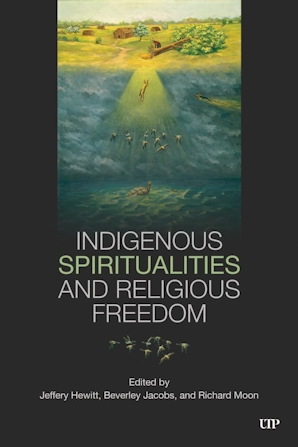
Indigenous Spiritualities and Religious Freedom
Edited by Jeffery Hewitt, Beverly Jacobs and Richard John Moon
From the publisher:
“Indigenous Spiritualities and Religious Freedom investigates the complex relationship between Indigenous legal orders and Canadian law, emphasizing the richness of Indigenous spiritual practices alongside their historical and ongoing suppression by the Canadian state. It critically examines the role and limitations of the Canadian Charter of Right’s section 2(a), which guarantees freedom of religion, in protecting the spiritual lives of Indigenous communities. The book highlights the holistic nature of Indigenous spiritual beliefs, which view the spiritual as immanent and closely tied to land and specific locations. The book reveals how, by contrast, the Anglo-American conception of religious freedom often separates spiritual and religious matters from civic and political concerns, and so fails to provide meaningful protection for Indigenous cultural and spiritual practices. Many essays in this collection propose alternative approaches to the relationship between Canadian law and Indigenous legal orders, particularly regarding Indigenous spiritual practices. Ultimately, Indigenous Spiritualities and Religious Freedom reveals the challenges – and perhaps the futility – of seeking significant protection for Indigenous spiritual practices within the existing framework of religious freedom.”
Movement and Indigenous Religions
Edited by Meaghan Weatherdon and Seth Schermerhorn
From the publisher:
“This edited book brings together leading scholars in the field of Indigenous religions working with Indigenous Peoples from the United States, Canada, Mexico, and Europe to examine various Indigenous discourses, practices, and politics of movement, as they intersect with issues of religion and spirituality.
Indigenous Peoples and their religious traditions have always been mobile and adaptive. Scholars of Indigenous religions have tended to focus their theories of Indigeneity and religion on Indigenous Peoples’ cultural and historic connections to particular land-bases, not always attending to the full complexity of Indigenous Peoples’ mobile lived realities. Attention to mobility within the study of Indigenous religions reveals the many ways Indigenous religions, in addition to being grounded on the land and situated in shared pasts, are expansive, relational, innovative, and future oriented. The contributions to this volume highlight the centrality of mobility to cultivating personhood, maintaining networks of affinity and belonging, fostering political alliances and solidarities, and generating religious meaning."
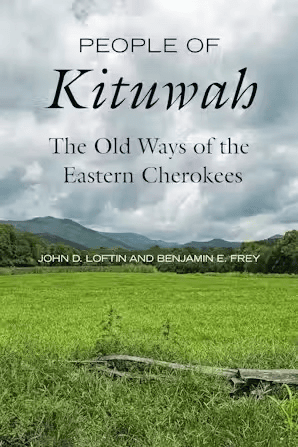
People of Kituwah: The Old Ways of the Eastern Cherokees
By John D. Loftin and Benjamin E. Frey
From the publisher:
“According to Cherokee tradition, the place of creation is Kituwah, located at the center of the world and home to the most sacred and oldest of all beloved, or mother, towns. Just by entering Kituwah, or indeed any village site, Cherokees reexperience the creation of the world, when the water beetle first surfaced with a piece of mud that later became the island on which they lived. People of Kituwah is a comprehensive account of the spiritual worldview and lifeways of the Eastern Cherokee people, from the creation of the world to today. Building on vast primary and secondary materials, native and non-native, this book provides a window into not only what the Cherokees perceive and understand-their notions of space and time, marriage and love, death and the afterlife, healing and traditional medicine, and rites and ceremonies-but also how their religious life evolved both before and after the calamitous coming of colonialism. Through the collaborative efforts of John D. Loftin and Benjamin E. Frey, this book offers an in-depth understanding of Cherokee culture and society.”