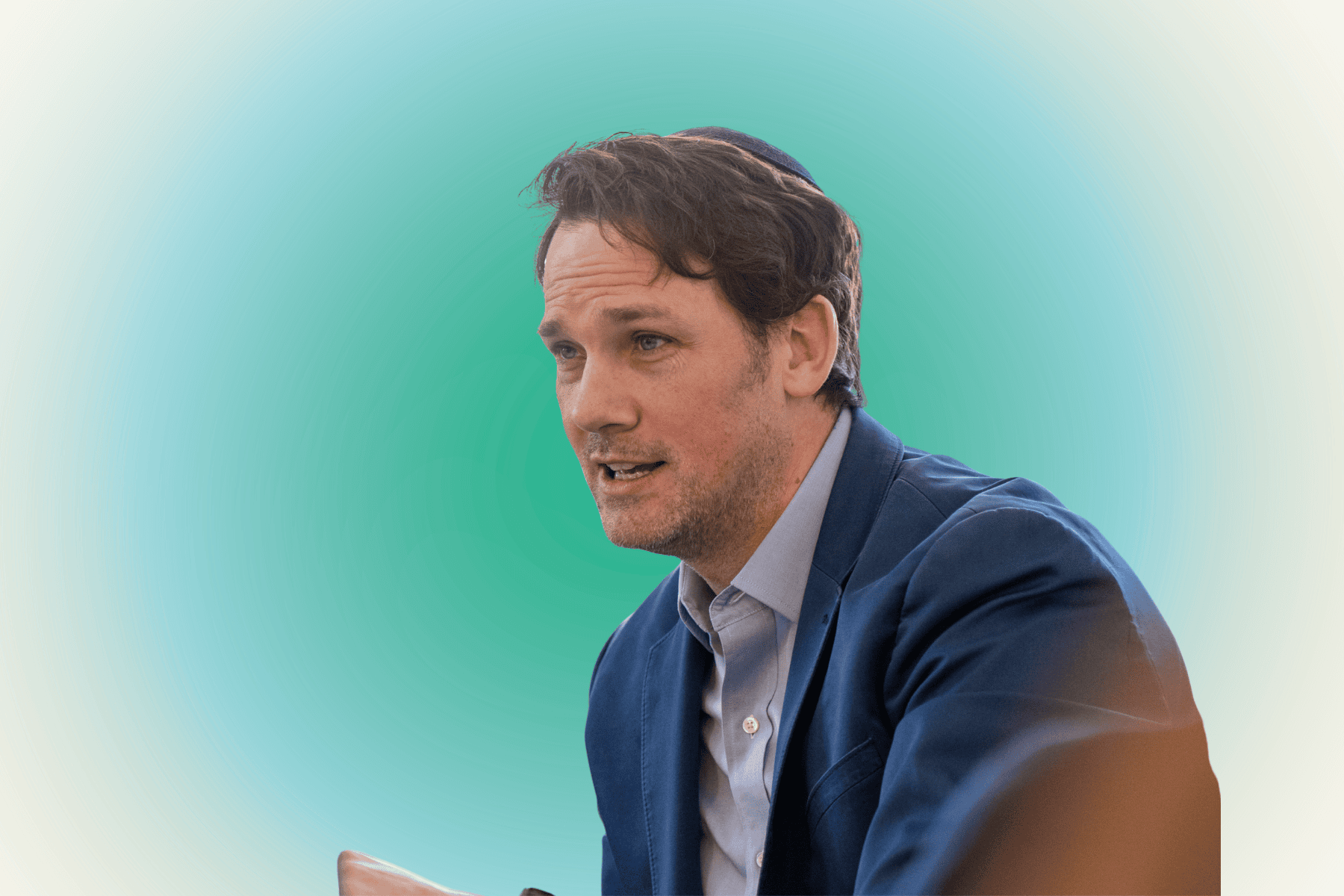
We regularly spotlight members who are making waves in their departments, institutions, communities, or within AAR. If you would like to submit a member to be interviewed, please email communications@aarweb.org with the member’s name and a brief message on why they are a good candidate. Read more of our Member Spotlight interviews.
About Yonatan
Yonatan Y. Brafman (he, him) is associate professor of Modern Judaism in the Department of Religion, with a secondary appointment in the Department of Literary and Cultural Studies, as well as Director of the Program in Judaic Studies at Tufts University. He is also an affiliated scholar at the Brodie Center for Jewish and Israeli Law at Yale Law School.
Brafman is the author of Critique of Halakhic Reason: Divine Commandments and Social Normativity (Oxford University Press, 2024), which was published as part of the AAR-OUP Reflection and Theory in the Study of Religion Series. Additionally, he is co-editor, with Suzanne Last Stone, of Jewish Law: New Perspectives (De Gruyter, 2024), and with Leora Batnitzky, of Jewish Legal Theories: Writings on State, Religion, and Morality (Brandeis, 2018). His articles have appeared in leading journals, including the Journal of Religious Ethics, Jewish Studies Quarterly, and Diné Israel: Studies in Halakhah and Jewish Law.
Previously, Brafman served as assistant professor of Jewish Thought and Ethics and Academic Director of the Handel Center for Ethics and Justice at the Jewish Theological Seminary of America. He has held research fellowships at the University of Pennsylvania, Princeton University, New York University Law School, and the Benjamin N. Cardozo School of Law, Yeshiva University. He earned his PhD in Philosophy of Religion and Jewish Thought from Columbia University, where he also received his BA, MA, and MPhil.
What is your area of expertise or field of study?
I am a philosopher of religion and a scholar of modern Judaism. My research explores the intersection of Jewish thought and law (halakhah) and contemporary moral, legal, and political philosophy. My first book, Critique of Halakhic Reason, examined reflection on the Jewish commandments among 20th century Jewish thinkers as well as presented a philosophically constructive account of normativity, reasons, and authority that it applied to Jewish law. I also examine the implications of religious ritual for critical social theory and practice, most recently in an article entitled “Beyond Values to Critical Praxis: The Future of Jewish Ethics.”
My next project investigates the conceptual conditions and consequences of construing Jewish texts, norms, and practices as constituting a discrete object—Jewish law—capable of separation from other discourses—like theology, ethics, and politics—and domains of life and subsequently subject to systematization.
Why did you get involved with AAR, and how is your work aligned?
Growing up in an Orthodox Jewish community, I knew as soon as I got to university that I wanted to study religion academically, without any barriers to inquiry. I was trained in religion departments, first at Columbia as an undergraduate and graduate student, and then at Princeton on a postdoctoral fellowship. And so, reading the Journal of the American Academy of Religion and attending the Annual Meetings followed naturally.
My work spans Jewish Studies and Philosophy, and I also attend those conferences and read those journals; however, AAR has allowed me to have the types of wide-ranging and interdisciplinary conversations that are generative for my work. My book, for example, not only studies modern Jewish thinkers and analyzes philosophical concepts, but questions whether uniquely religious reasons exist. This can only take place within the framework of the AAR. In fact, that book was published in the AAR’s Reflection and Theory in the Study of Religion series.
What is your favorite AAR member benefit, and how has it helped your career?
To be honest, my favorite member benefit has got to be the online job listings. When I was on the job market, I probably checked it way too much! And it helped me find a position that I love in the religion department at Tufts University. I haven’t checked it since.
What is one piece of advice you’d give to a first-time Annual Meeting attendee?
If you hear a talk that interests you, go strike up a conversation with the presenter, even and perhaps especially if they are more advanced in their career than you. I met two incredible scholars, mentors, and now friends—Randi Rashkover and Martin Kavka—at AAR meetings. In my experience at the Annual Meeting, established colleagues take a genuine interest in the work of emerging scholars and strive to help them.
What book is on your nightstand that you’re reading or intend to read in the future?
Right now, I’m reading Kevin Vallier’s All the Kingdoms of the World: On Religious Alternatives to Liberalism, and it’s keeping me up at night. We in the study of religion know well the deficiencies of political liberalism—abstract universalism, Protestant bias, etc.; however, the emerging forms of religious illiberalisms, including but not limited to Catholic integralism—Vallier’s focus—urgently demand our critical attention. As it turns out there are much worse things than Rawlsianism!
What do you enjoy doing outside of work?
Outside of work, I run, bike, as well as play basketball and squash. But most of the time, I’m helping to take care of three kids, ages 11, 7, and 2. They keep me pretty busy!
News Source