
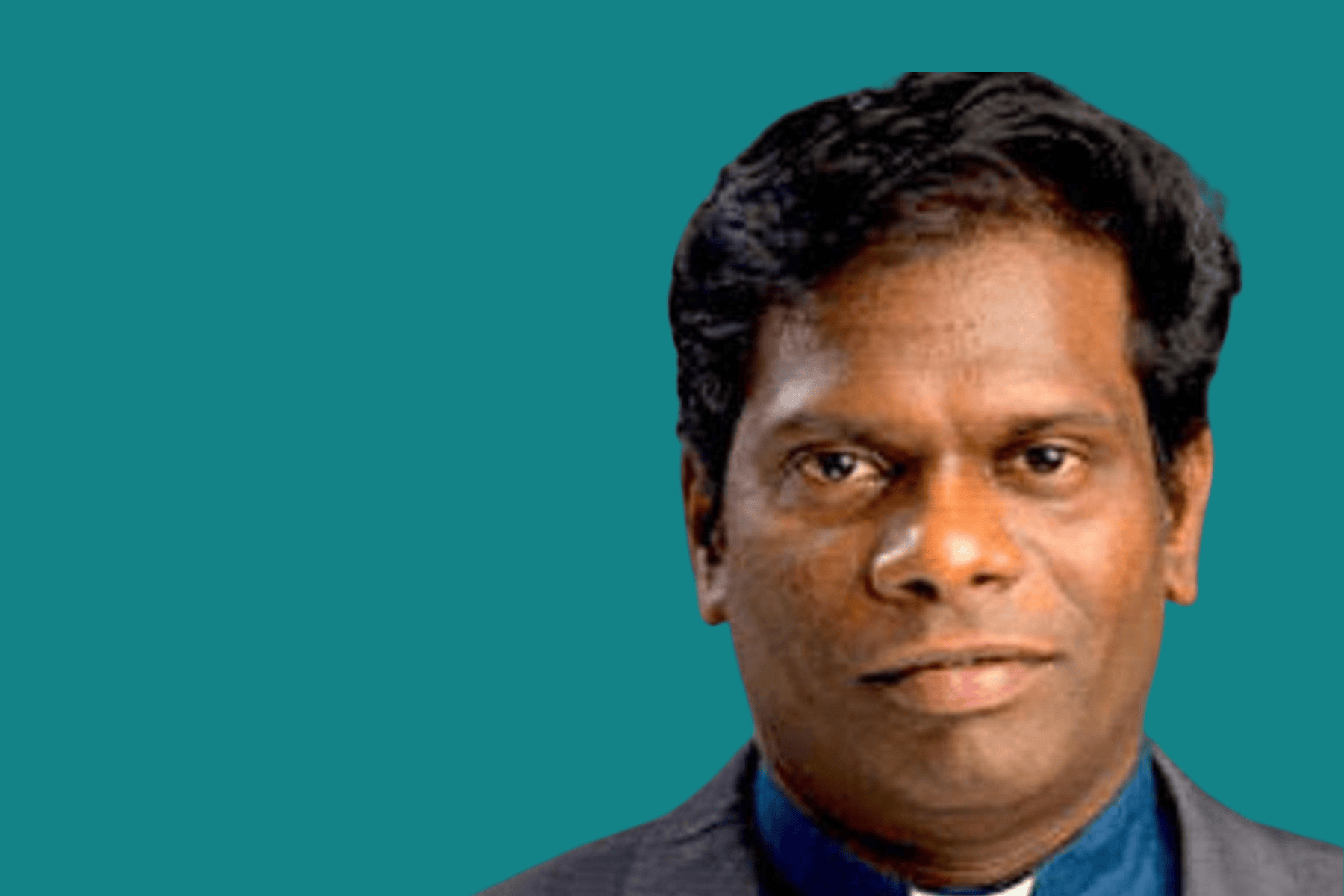
We regularly spotlight members who are making waves in their departments, institutions, communities, or within AAR. If you would like to submit a member to be interviewed, please email communications@aarweb.org with the member’s name and a brief message on why they are a good candidate. Read more of our Member Spotlight interviews.
About Baiju
Baiju Markose, Ph.D. (he/him) is an assistant professor of theology at Trinity Lutheran Seminary at Capital University in Columbus, Ohio, where his teaching and research focus on systematic and constructive theologies as well as interreligious studies. He previously served as professor of religion and dean of studies at Dharma Jyothi Vidya Peeth Seminary in Faridabad, India. He served as auxiliary faculty at Gurukul Lutheran Seminary in Chennai. He has also been a visiting professor at the Lutheran School of Theology at Chicago, where he earned his Ph.D. in 2019.
A theologian, poet, and author, Dr. Markose has published six books, including Notes from the Edges: Theological Intonations (2021), The Cross and the Peacock (2021), and Rhizomatic Reflections: Discourses on Religion and Theology (2018). His work extends beyond the academy through active contributions to interfaith engagement and global advocacy. He has coordinated the Global Climate Justice Interfaith Peacemaker Team (CJIPT) of the OMNIA Institute for Contextual Leadership in Chicago and most recently served as a co-researcher on the book project An Earthed Faith: Telling the Story amid the Anthropocene. In 2017, Markose received the Marion McFarland Award as well as the Best Graduate Paper Award at the AAR Midwest Regional Meeting.
What is your area of expertise or field of study?
My expertise lies at the convergence of postcolonial theology, theopoetics, and the philosophy of religion. My research traverses a diverse range of fields, including intersectional theologies, climate justice, new materialism, ethnography, subaltern eco-spiritualities, interfaith peace studies, epigenetics, neurotheology, and the ongoing dialogue between science and religion. Currently, I am engaged in two projects: one exploring Christology through the lens of subaltern eco-theopoetics, and another investigating the creolization of interfaith studies.
Why did you get involved with AAR, and how is your work aligned?
Many years ago, while studying theology in India, I longed to read an article published in the JAAR. Unfortunately, it was not accessible locally at that time, and the disappointment left a deep impression on me. That longing, however, planted the dream of one day connecting with AAR and subscribing to its journal—a dream that eventually came true. Later, during my doctoral studies at the Lutheran School of Theology at Chicago, I was honored to receive the Marion McFarland Award, as well as the Best Graduate Paper Award, in 2017 at the AAR Midwest Region Annual Conference. These recognitions were both humbling and deeply inspiring for me as an emerging theologian and researcher. Altogether, these experiences further encouraged me to become more actively involved with AAR. I also value the fact that within AAR, every voice has the opportunity to be heard.
What is your favorite AAR member benefit, and how has it helped your career?
One of my favorite membership benefits is the travel grant. I was fortunate to receive the grant twice, which made it possible for me to attend the annual conferences and present papers. I also deeply value the professional development resources, notably the Inclusive Pedagogy Certificate Series, which I completed a few years ago.
What is one piece of advice you’d give to a first-time Annual Meeting attendee?
Set aside time to attend presentations outside your own field and dare to do some adventure—you may discover unexpected insights that spark fresh ideas or even reshape the course of your research.
What book is on your nightstand that you’re reading or intend to read in the future?
Right now, I’m alternating between Robin Wall Kimmerer’s The Serviceberry and Octavia Butler’s The Parable of the Sower, with David Whyte’s Consolations always by my side.
What do you enjoy doing outside of work?
I love wandering through liminal spaces where the land meets the water, across stretches of sand and scattered pebbles. Pebble Beach in Chicago is one of my favorite places—it always evokes memories of the riverbank near my childhood home in India. These days, I find a quiet joy almost every morning as I walk into the woods in Bexley, Ohio.