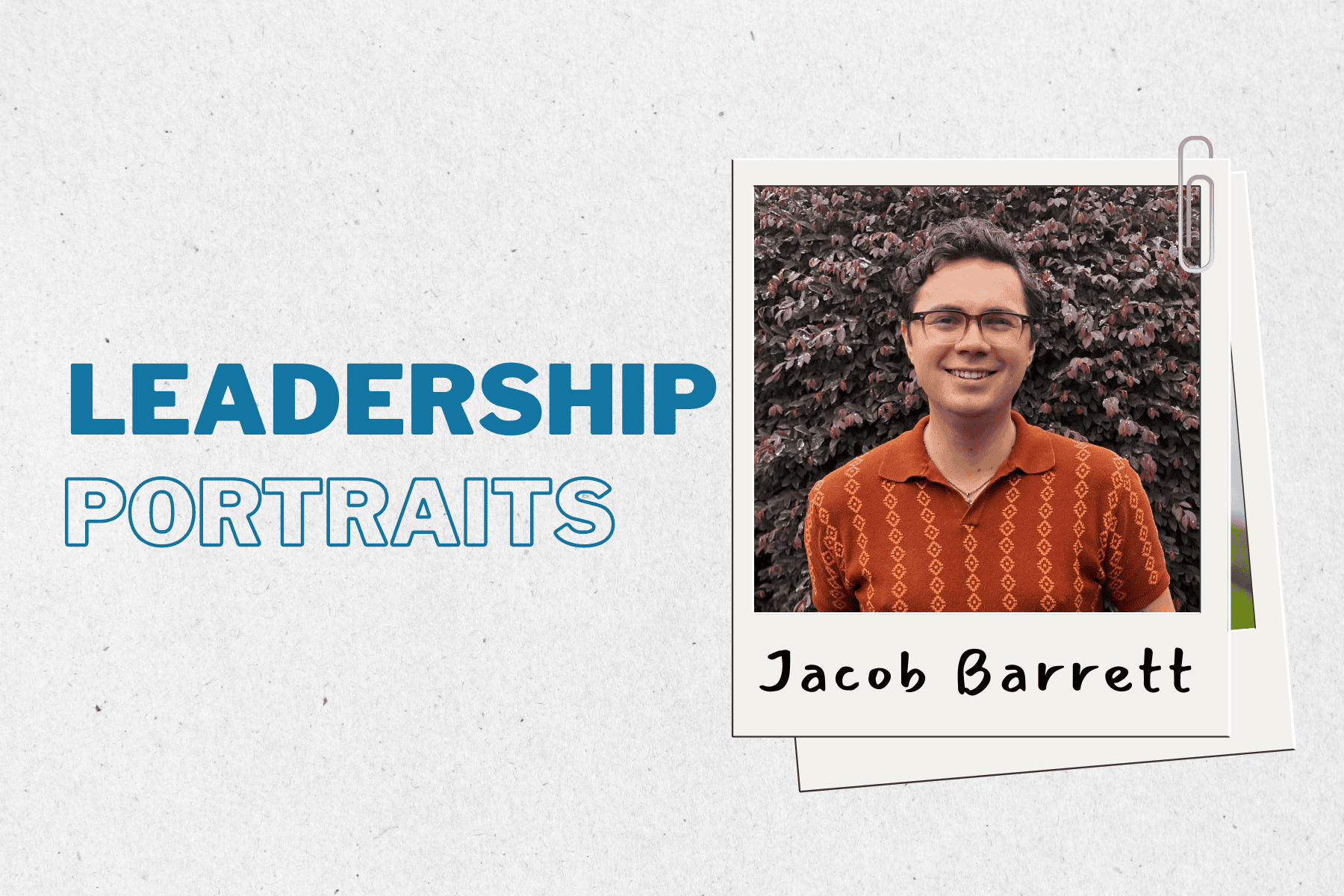
Jacob Barrett, Student Director of the AAR Board of Directors and Chair of the Graduate Student Committee, calls on Religious Studies faculty and scholars to remember that graduate students are not just the future of the field, but present members of it, in need of recognition and support.
Refusing the Future
There is a statement I have heard at nearly every AAR gathering I’ve attended. It appears in welcome remarks, in reception toasts, in the closing minutes of plenaries, and most often in the Q&A session after a graduate student has just presented excellent work. It is almost always offered with real warmth and genuine enthusiasm: graduate students are the future of the field.
I want to take that statement seriously enough to refuse it.
This year’s presidential theme is “Future/s,” and it is a fitting one for a moment in which so much about our field feels uncertain. As someone who spends most of his days reading queer theory and writing about futurity, though, I have learned to be wary of what the future can be made to do. In No Future: Queer Theory and the Death Drive (2004), Lee Edelman describes the way political life organizes itself around the figure of the Child – an image of the future on whose behalf every sacrifice can be asked and every present harm’s solution postponed. The Child is endlessly invoked and endlessly protected, and for exactly that reason it never gets to be anyone in particular. The figure works precisely because it is empty. It is innocent, universal, and without needs that anyone has to actually meet, which is what makes it something everyone can claim to be acting on behalf of. Consider how readily our politics will mobilize around what we owe our children and the world we are leaving them, all while actual children in this country go hungry, sleep in shelters and cars, and are killed in their classrooms. The Child in whose name we speak is not any of them. The figure is cherished while the children are left to wait.
Graduate students know something about being made into that kind of figure. To be “the future of the field” is to be the place where the field deposits its hopes, and that turns out to be a demanding job. It means being asked to be patient even though our funding runs out years before we can meet degree requirements. It means being asked to perform optimism about a job market that has given us little reason for such optimism, and to keep our despair out of cover letters, conference receptions, and our advisors’ offices. It means being asked, quietly, to reproduce the field in the shape it already has, to write the dissertations hiring committees will recognize, and to grow up into versions of the people who are hoping in us. And it means, most of all, being asked to perform gratitude: for the stipend that doesn’t cover rent, for the opportunity to teach for less than a living wage, for the privilege of being told, again, that we are the future.
In my role as Student Director for the AAR Board of Directors, I most often encounter the expectation that graduate students should be grateful simply to have a seat at the table. I am not. I am grateful for a great deal about this work, but the seat is not one of those things because it is not a gift. Graduate students are the AAR’s largest membership constituency. We present papers, organize sessions, serve on program unit steering committees and AAR standing and status committees, and teach the courses that keep religious studies in front of undergraduates. We are not guests the organization has kindly made room for at its table; we are a large part of what the organization is, and we are here now.
So, I understand my role as Student Director as a refusal of futurity, or at least of the version of it that Edelman so rightly critiques. My job is not to represent the scholars graduate students might someday become. It is to advocate for the people graduate students are today, and to address the conditions under which we currently live, work, and too often suffer.
These conditions are not abstract. In June 2024, under the leadership of my predecessor, Ristina Gooden, the Graduate Student Committee surveyed student members about their experiences and struggles. We presented the results in a webinAAR and then developed them into an open letter series in Religious Studies News, written to faculty and administrators. What students told us was hard to read. Financial insecurity was their most pressing concern by a wide margin, with many noting stipends that no longer kept pace with the cost of living, experiences with juggling second and third jobs, and debt taken on to buy groceries. Others described a job market that made them feel like they’d been sold a dream that wasn’t attainable. They rated their programs’ preparation for that market, for publishing, and for teaching their own courses below the midpoint.
Many described keeping all of this hidden from the faculty meant to support them. As one respondent aptly put it, “We suffer more than they will ever really know because it’s not safe for that to be known.” Students reported concealing their struggles in part because the person who would hear the confession is often the same person who writes the recommendation letter and evaluates their progress, and because advice that assumes, as one student put it, “a level of wealth and class privilege that many of us do not possess” teaches a student fairly quickly what can and cannot be said in that office.
When we introduced that open letter series, we wrote that graduate students are both the labor of our present and the future of our field. If I were to rewrite it today, I would put all the weight on the first half of that sentence. What students need is not the recognition of our future potential. What we are asking for is attention to the struggles being experienced today, in real time, by current members of this organization.
What does it look like to govern for the present? Mostly, it looks like collaborative, unglamorous work, and I want to be clear that it is the Graduate Student Committee’s work, not mine alone. Allison Isidore, Lauren Tassone, Casey A’Hearn, Erica Johnson, and Yanchen Liu are all instrumental in the work I have been able to do from my position. In the last few months, we’ve convened a group of international students to speak about their unique experiences and challenges, as their needs are too often an afterthought in an organization that still imagines its members as domestic by default. We are launching a peer mentorship program, because many students need support that they are not finding in their departments. We are organizing a job market panel at the Annual Meeting that tries to tell the truth about that market. And we are developing a webinAAR on how graduate students can get involved with program unit steering committees, because steering committees are where much of the field’s intellectual agenda gets set, and students should be in those rooms shaping it rather than waiting to inherit it. There is more in the works, and more to be done.
It would be easy to describe all of this as an investment in the future of the field, and I suspect some of it will be received that way. None of these projects, though, are really about the future. A mentorship program matters because a student is struggling this semester. A job market panel matters because people are applying this cycle. A webinAAR on steering committees matters because the decisions those committees make this year shape the field students are working in now. Each project begins from the simple premise that graduate students have present needs, present contributions, and present claims on the organization we belong to.
This is what I mean by refusing futurity. It is not a refusal of hope, and it is not despair about where the field is headed. It is a refusal to let the future remain the place where graduate students’ needs get deferred, where our struggles become the price of someday and our contributions become promissory notes. The Child in Edelman’s account never actually arrives; the future it stands for stays one step ahead, always justifying one more sacrifice. The “future of the field” is always one step ahead, but real graduate students are here now, and we cannot afford to wait
So the next time a graduate student finishes presenting work that impresses you, I’d ask you to hold back the sentence I started with. Tell them what was good about the work. Ask how we are doing, and mean the question. If you have said that sentence before, and most of us have, I am not asking you to stop hoping. I am asking you to notice what hope can allow us to postpone. The graduate students in your department are not the future of the field. We are members of it, doing its work under conditions that deserve your attention now. Read our open letters. Ask your students what they need. Then act as though the answer is urgent, because it is.
There is no future of this field that does not pass through its present. The present is where the work is being done, where the struggles are being lived, and where this organization will either show up for its members or not. It is where graduate students already are, so come find us.
Jacob Barrett is a PhD Candidate in the Department of Religious Studies at the University of North Carolina at Chapel Hill in the Religion and Culture track. His dissertation, Intimately Governed: Sex, Religion, and the First Amendment, draws on queer theory and critical religion to analyze religious freedom as a mechanism of intimate governance, including the ways American law uses notions of “proper marriage” and “parental rights” to assert authority over intimate life and shape the lives of its citizens. His writing has appeared in Implicit Religion and a number of edited volumes, and his public scholarship includes hosting interviews for the New Books Network podcast. He also leads the social media teams for The Religion Department and Under Gods, a digital project with the Henry Luce Foundation and the Smithsonian’s National Museum of American History.
Leadership Portraits is a monthly Religious Studies News (RSN) series that introduces readers get to some of the leaders within the American Academy of Religion.
News Source