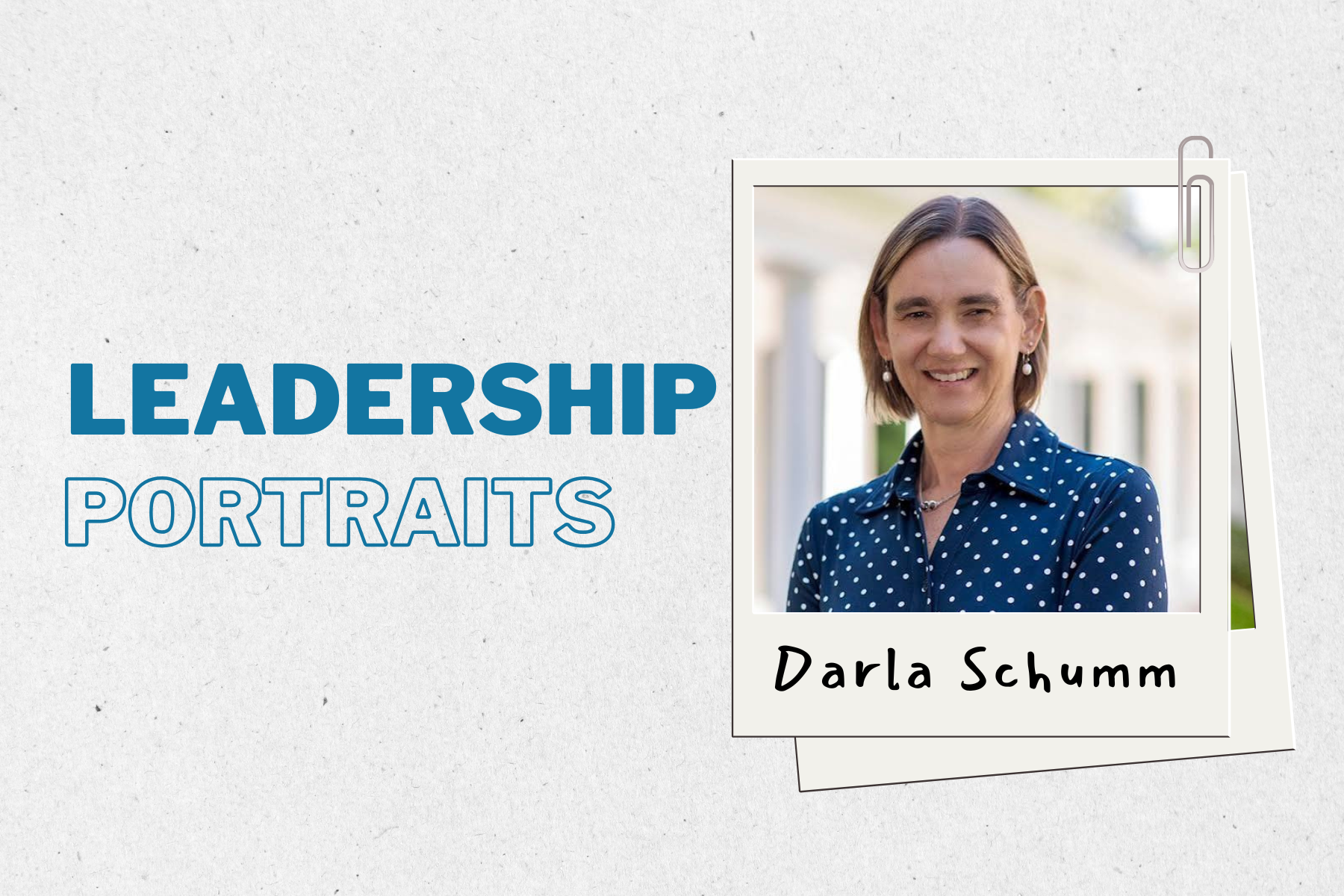
Darla Schumm is the Associate Provost for Curriculum and Faculty Engagement and Professor of Religious Studies at Hollins University in Roanoke, Virginia. Her research focuses on the intersections of religious and disability studies. Her most recent book, Healing Ableism: Stories about Disability and Religious Life was published by Rutgers University Press (2025). She enjoys speaking and teaching about disability and religion, and working with religious groups and organizations to consider how they can build more accessible and inclusive communities. Schumm was an inaugural member of the AAR’s Status of People with Disabilities in the Professions Committee, and she chaired the committee for three years.
What is your position on the AAR Board of Directors and Program Committee? What exactly do you do in your role?
I am one of the two at-large members of the AAR Board of Directors. My at-large position also means that I sit on the AAR Program Committee. As a Board member, I believe my primary role is to advise, support, and evaluate the Executive Director, monitor the financial health of the organization, and ensure that the Board, staff, and members remain faithful to the mission of the AAR. As a member of the Program Committee, I spend my time reviewing program units, thinking about challenges such as the overwhelming proliferation of units and annual meeting sessions, and supporting the staff in offering a virtual and in-person annual meetings each year.
What do you think AAR members would find surprising about your work on the board and committee?
For many years I attended the annual meeting, presenting papers and learning from colleagues. I certainly understood that organizing a conference of this size was no easy task, but before sitting on the Board of Directors and participating on the Program Committee, I had no idea how much time, energy, and money are required to pull off one, let alone two Annual Meetings every year. Moreover, I was relatively unaware of the vast array of programs, support services, and initiatives the AAR offers prior to my time on the Board. You may accuse me of being naive and uninformed, and you may be right, but I’m guessing that many of you are guilty of the same.
What is the best book you read or movie you watched this past year?
I devour fiction in my spare time, so to pick just one favorite book is akin to asking a parent to pick their favorite child—I only have one child, so not a problem I have! Nevertheless, one of the best books I read this past year was The Correspondent by Virginia Evans. The epistolary format offers readers an intimate portrait of grief, hope, and love, themes with which many of us in the AAR often consider. If you have not yet read it, I encourage you to check it out.
How do you explain to others that “religious studies matters”?
At the risk of sounding “cheeky,” I simply tell people to read the news, or observe the many political, social, and moral challenges of our time when attempting to underscore why “religion matters,” or why religious studies remains an essential component of the academy. I find this is the clearest evidence for cultivating the public engagement of religion and religious studies scholars. I am not suggesting that religion has all the “answers;” rather, I try to explain how religious studies helps us ask our leaders, students, and one another relevant and important questions.
Tell us something about yourself that people might find surprising.
I’m a blind power lifter who knits obsessively! These realities aided me in developing characteristics that I have applied to my work on the Board of Directors and Program Committee: grit, determination, creativity, problem-solving, persistence, patience, and most importantly, the belief that I/we can do hard things.
Leadership Portraits is a monthly Religious Studies News (RSN) series that introduces readers get to some of the leaders within the American Academy of Religion.
News Source