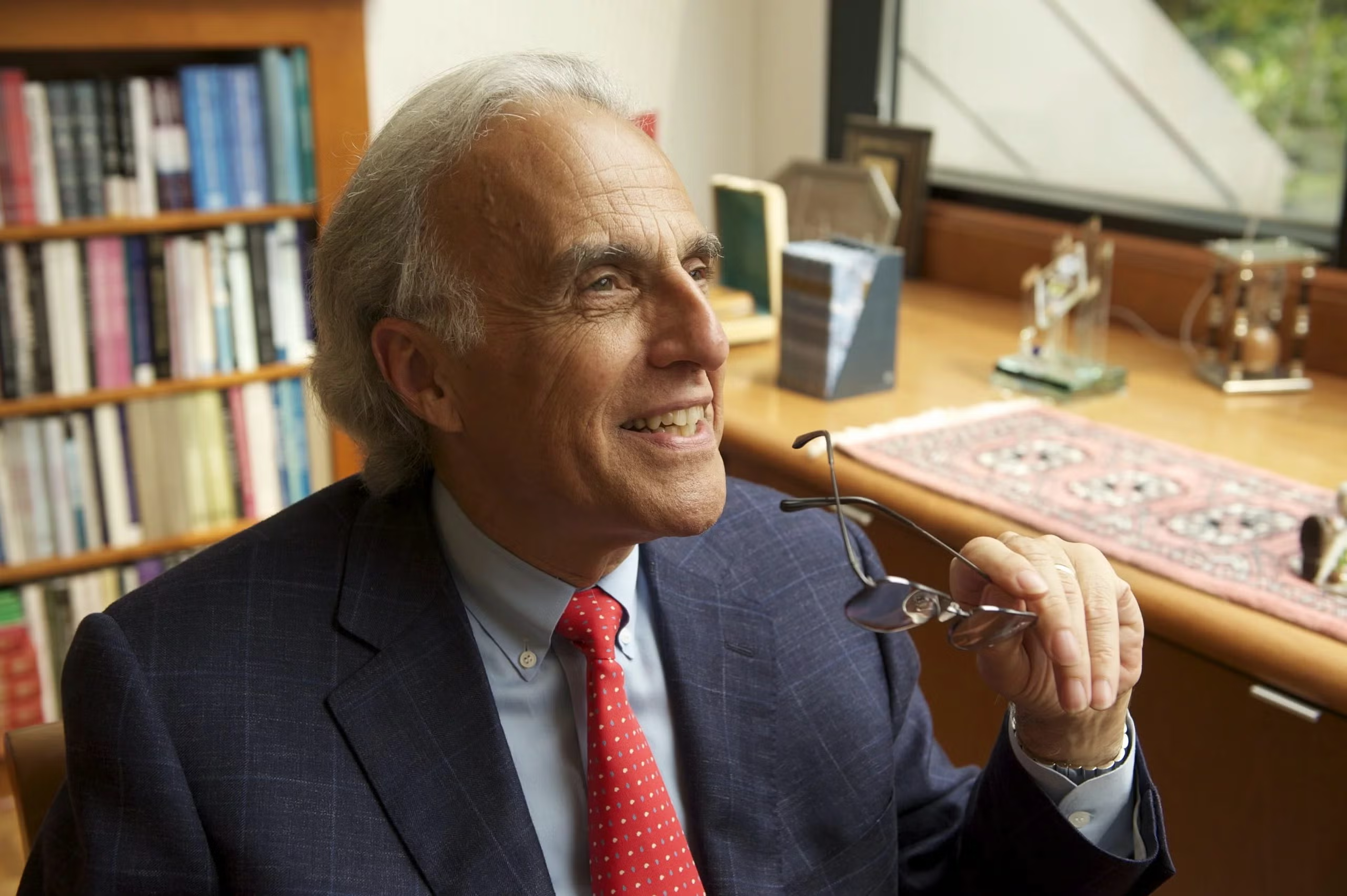
Prepared for the American Academy of Religion and Religious Studies News by Dr. Natana J. DeLong-Bas, who is Professor of the Practice of Theology and Islamic Civilizations and Societies, and Director of the minor in Theology and Interreligious Studies at Boston College.
One of the most influential and visionary scholars of Islam of his generation and an expert builder of bridges between Muslims and Christians around the world, John L. Esposito passed away at the age of 86 on July 15, 2026, leaving a legacy of interreligious understanding, scholarship, institutions, generous mentorship, and personal and professional integrity and commitment to peace through justice that will continue to resonate globally through his networks of students, colleagues, friends, and family long into the future.
Born May 19, 1940, in Brooklyn, NY, to the late John and Mary Esposito, John was the oldest of three sons. An Italian Catholic, John spent 10 years in a Capuchin Franciscan monastery before finding himself drawn to a vocation in the academy. He left the monastery with a strong moral compass and deep understanding of faith as an orientation for life, not just a belief system.
John completed a B.A. in Philosophy at St. Anthony’s College in 1963 and an M.A. in Theology from St. John’s University in 1966. He intended to pursue a Ph.D. in Catholic Theology at Temple University, but a one-year requirement to study world religions brought him into the orbit of Palestinian-American scholar Isma’il Raji al-Faruqi, an expert on both Islam and Western thought. Under al-Faruqi’s mentorship, John learned to engage Muslims as people, rather than through doctrines or the lens of Western anxieties and security concerns. His coursework at Temple and study of Arabic in Lebanon connected him with Muslim students from around the world, from Egypt to Malaysia and Indonesia, providing him with a lens into the variety of practices and understandings of Islam globally. John completed his Ph.D. in Islamic Studies with a minor in Comparative Religion in 1974. He taught World Religions and Religious Studies at the College of the Holy Cross in Worcester, MA, from 1975 until 1995 when he moved to Georgetown University in Washington, DC.
John was recruited by Georgetown University in 1993 to become the Founding Director of the Center for Muslim-Christian Understanding, later renamed the Prince Alwaleed Center for Muslim-Christian Understanding (ACMCU), in the Walsh School of Foreign Service. The Center’s founding mission embraced the value of bringing together members of the world’s two largest faith traditions – Christianity and Islam, respectively – which combined account for more than half of the global population. Under John’s leadership, ACMCU became one of the world’s leading institutions for interreligious dialogue, engagement and cross-cultural encounters, while hosting scholars, religious leaders, and policymakers from around the world. During his tenure as ACMCU director, John also founded and directed the Bridge Initiative in 2015, a multi-year research project promoting pluralism and documenting Islamophobia in Europe and North America, particularly its impact on and presence in public policy, the media, and civil society.
John’s career gained international recognition with the Iranian Revolution in 1978-79 when there was little awareness or understanding of Islam. His unique ability to engage the intersection of religion and politics, combined with his deep understanding of Islam, led to him being one of the first American scholars permitted to visit the Islamic Republic of Iran and interview Ayatollah Khomeini and his family. He was also called upon to educate American diplomats, State Department officials and foreign policy experts on the global resurgence of Islam, particularly its political dimensions and implications. He similarly worked to bring the study of Islam into the American Academy of Religion, marking it as a serious field of study in its own right, rather than a security threat in need of containment.
Throughout the 1980s, John expanded his work as a public intellectual, reshaping the understanding of Islam and Muslims in significant public spaces – diplomacy, foreign affairs, policymaking, the media, and public opinion – insisting that the surrounding contexts of colonialism, authoritarianism, and social dislocation in many Muslim majority countries be considered in any attempted explanation of events and developments. Although sometimes criticized for being too generous in his interpretation of particular Muslim actors, John reminded his critics that scholarship and understanding are not the same as endorsement and that working for peace requires asking hard questions and seeking to understand another person’s perspective, not necessarily agreeing with it or bringing everyone to consensus. He further noted that loving a country should not be equated with blindly supporting any and all actions it takes; sometimes tough love is also needed to point out where there are errors or injustices so that corrective steps can be taken. John believed that was as true of the United States as it was of other countries.
John deconstructed misguided, inaccurate, and even fabricated negative and threatening portrayals of Islam and Muslims that posited them as civilizational adversaries, particularly post-9/11. He grounded his arguments and analyses in empirical data that he used to inform rather than inflame. He honed his deep knowledge and experience to craft a nuanced and complex mosaic of Islam as a lived, dynamic and ever-evolving faith and tradition, differentiating between a minority of radical extremists and the mainstream majority. He identified and called attention to root causes that create the circumstances in which religion can be appropriated and exploited for political purposes.
John envisioned a society where Muslims and Christians alike would have a voice and a stake in crafting a pluralistic vision of a just and peaceful society. He dedicated his life to bringing believers together because of their faith, not despite it, out of belief that personal conviction of the truth of one’s own religion should come with interest in and respect for the religious beliefs and practices of others. His approach to interreligious encounter called for engagement and ethical commitment on both sides. He called for upholding differences in beliefs but emphasizing shared values of love of God and neighbor, caring for the poor and marginalized, striving to live righteously, standing up for justice, speaking truth to power, and protecting the environment as God’s precious creation and gift to all forms of life. Where others chose to build barriers to shut difference out, John chose to bring people together so that they might get to know and learn from one another, believing in the power of interfaith dialogue and engagement to promote religious freedom and human dignity and build a culture of mutual respect and understanding.
John exemplified the best of what it means to be an American – gracious in hospitality and friendship; engaged in diplomacy as the appropriate means for addressing disagreement, harm and misunderstanding; courageous and insistent upon upholding the First Amendment rights of freedom of religion, speech, and the press so that all voices might be heard; defender of the right to assemble freely without fear of persecution or violence, especially for religious observance; and supporter of the right to demand redressing of grievances from the government, particularly where violations of civil and human rights have occurred.
John was elected president of multiple major academic organizations – the American Academy of Religion (AAR, 2013), the Middle East Studies Association (MESA,1998), and the American Council for the Study of Islamic Societies (ACSIS, 1989-1992). He was the Vice Chair of the Center for the Study of Islam and Democracy and served as an advisor for the PBS documentary film Muhammad: Legacy of a Prophet, viewed by over 10 million people in the US alone.
John’s prolific writing career produced more than 50 books, beginning with Women in Muslim Family Law (rev. ed. with Natana J. DeLong-Bas) and continuing with some of his best-known works – Islam: The Straight Path (now in its 5th edition); The Islamic Threat: Myth or Reality? (now in its 3rd edition); What Everyone Needs to Know About Islam; Makers of Contemporary Islam (with John O. Voll); Islam and Democracy (with John O. Voll); Unholy War: Terror in the Name of Islam; Who Speaks for Islam? What a Billion Muslims Really Think (based on a multi-year research project with the Gallup Poll of over 50,000 interviews in more than 35 Muslim-majority countries, with Dalia Mogahed); and his final work, Shariah: What Everyone Needs to Know (with Natana J. DeLong-Bas), among others. His output also included a variety of foundational reference projects that have framed Islamic studies for generations of students, serving as Editor-in-Chief for The Oxford Encyclopedia of the Islamic World (6 vols.), The Oxford Encyclopedia of the Modern Islamic World (4 vols.), The Oxford History of Islam, The Oxford Dictionary of Islam, and The Islamic World: Past and Present (3 vols.), as well as Founding Editor of Oxford Islamic Studies Online and Series Editor of the Oxford Library of Islamic Studies. His books and articles have been translated into 35 languages.
Beyond the academy, John was a member of the World Economic Forum’s Council of 100 Leaders, the High Level Group of the UN Alliance of Civilizations, the E.C. European Network of Experts on De-Radicalisation and Board of Directors of the C-1 World Dialogue. He served as a consultant to the U.S. Department of State and other agencies, as well as European and Asian governments, international corporations, universities, and media worldwide. He regularly appeared on CNN, Al-Jazeera, ABC Nightline, CBS, NBC, and the BBC and wrote pieces for The Wall Street Journal, The New York Times, The Washington Post, The Economist, The Guardian, The Times of London, and the Middle East Eye. His interviews and articles have been read throughout the US, Europe, the Middle East, Asia and Africa.
John concluded his career as Distinguished University Professor Emeritus of Religion and International Affairs and Professor of Islamic Studies at Georgetown University. He was awarded seven honorary degrees from universities around the world and was the recipient of the American Academy of Religion’s Martin E. Marty Award for Public Understanding of Religion, Pakistan’s Quaid-i-Azzam Award for Outstanding Contributions in Islamic Studies, and the School of Foreign Service, Georgetown University Award for Outstanding Teaching. Yet John did not allow the accolades and celebrations to stand in the way of principle and integrity; he remained loyal to those whose work for justice, democracy, and a place for Muslims to participate in public life came under fire and even punishment and public silencing. In the age of the internet and social media, John’s voice will continue to speak truth to power through his many interviews and presentations – clearly, articulately, and unapologetically – with conviction and humor.
John is survived by his wife and life partner of 61 years, Jean, his adopted son, Emilio Gonzalez, and extended family, colleagues and friends. In lieu of flowers, the family has requested contributions to John’s final project, The Bridge Initiative on Islamophobia at Georgetown University:
Digital Donation: https://giving.georgetown.edu/cmcubridge
Physical Checks (should be made to Georgetown University’s Bridge Initiative on Islamophobia at ACMCU): https://acmcu.georgetown.edu/uncategorized/donate-by-mail/
Donate by Phone: https://giving.georgetown.edu/how-to-give/gift-instructions/#give-by-phone
News Source