
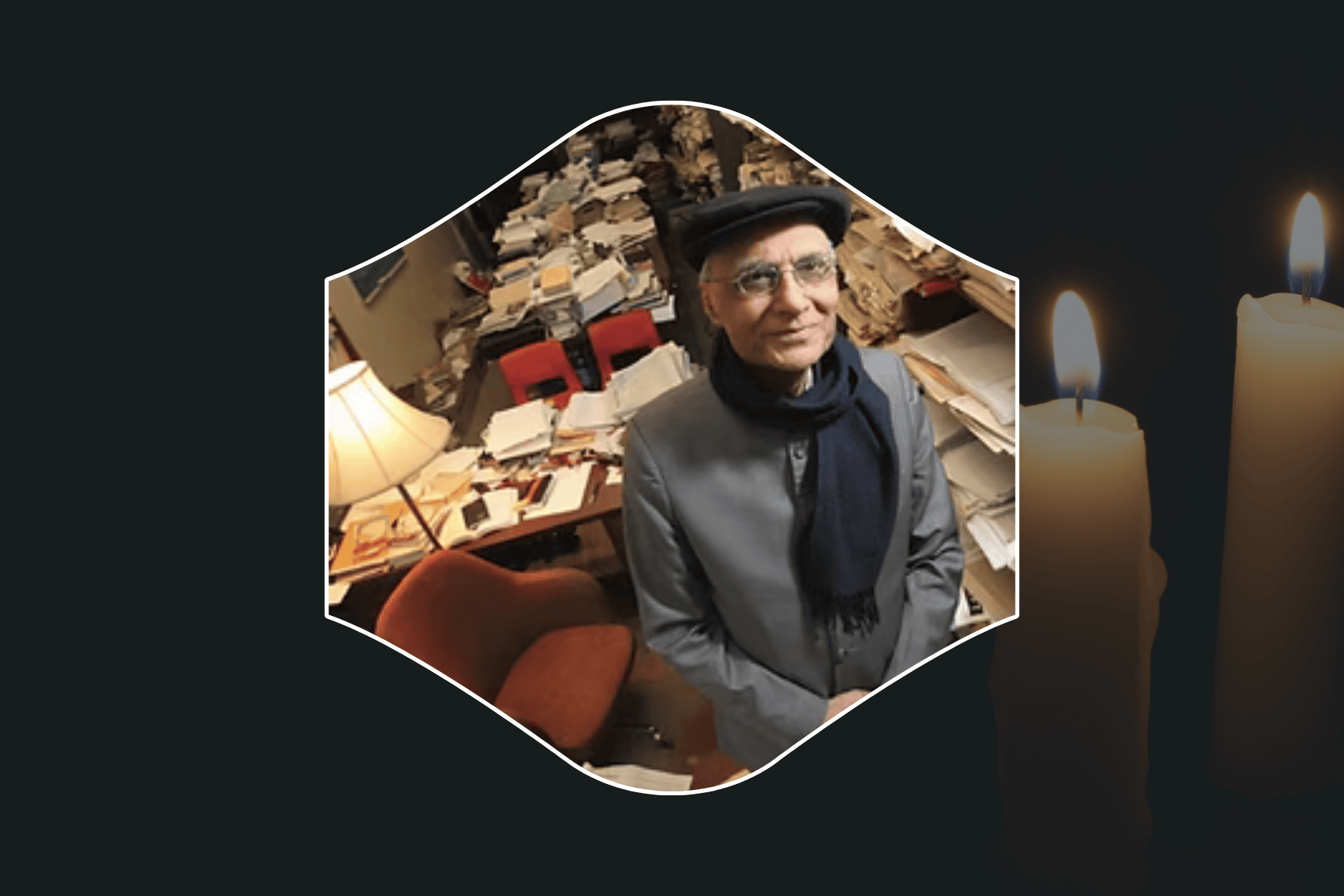
The AAR is saddened to share that Professor Arvind Sharma, Birks Professor of Comparative Religion at McGill University, died on September 29, 2026.
Over a distinguished scholarly career spanning five decades, Arvind Sharma made wide-ranging contributions to the study of Hindu thought, comparative religion, women and religion, religious pluralism, and human rights. Born in Varanasi, India on 13 January 1940, Arvind received his Bachelor of Arts from Allahabad University before joining the Indian Administrative Service in 1962. After six years in government service in Gujarat, Arvind undertook graduate study in the United States, where he received a Master of Arts in Economics from Syracuse University (1971) and completed a thesis exploring the intersections of Hinduism and development on the “Hindu Scriptural Value System and India’s Economic Development.” He then completed a Master of Theological Studies (1974) and Doctor of Philosophy (1978) from the Department of Sanskrit and Indian Studies of Harvard University. Arvind’s doctoral research at Harvard examined Abhinavagupta’s commentary on the Bhagavadgītā, which he later translated into English. Arvind’s first academic postings were in Australia, at the University of Queensland (1976–1980) and the University of Sydney (1980–1987). In 1987, Arvind joined the Faculty of Religious Studies of McGill University, becoming Birks Professor of Comparative Religion in 1994, a position he held until his passing.
An exceptionally prolific scholar, Arvind published more than 50 books as well as dozens of edited and co-edited volumes and hundreds of scholarly articles throughout his career. One of his final publications, Hindutva for Our Times (2025, Routledge), was based on a lecture series delivered as recently as 2023. His scholarly writing covered topics ranging from comparative world religions, Advaita Vedanta, and classical and modern Hindu thought to women in religious traditions, world religions and human rights, and religious pluralism. A consistent feature of Arvind’s work was its phenomenological and ethical focus on Hindu traditions and their contributions with a broader framework of comparative world religions. His edited volume, Our Religions: The Seven World Religions Introduced by Preeminent Scholars from Each Tradition, brought scholars affiliated with the traditions under discussion into a comparative conversation, while Feminism and World Religions, co-edited with Katherine K. Young, became a widely used text on women and gender in comparative religious studies. Arvind’s most widely cited publications include Women in World Religions, Feminism and World Religions, and Hinduism and Human Rights: A Conceptual Approach. Arvind sought to extend academic scholarship into wider interreligious and international conversations, notably through the global congress “World’s Religions After September 11,” first convened in Montreal in 2006. His later work increasingly addressed religious freedom, equality, human rights, and the place of Hindu traditions within global ethical discourse. In 2025, Arvind’s work was recognised with the conferral of the Padma Shri, India’s fourth-highest civilian honour, for his contributions to literature and education. His presence at McGill University will be greatly missed.
Submitted by Mikael Bauer, Director of the School of Religious Studies, McGill University