

Please join us in celebrating our members on their professional news and accomplishments!
As a reminder, AAR publishes member accomplishments including new publications, award announcements, and media mentions. Share your wins with us!
Books and Publications
Deborah E. Kanter
Pioneers of Latino Ministry: Claretians and the Evolving World of Catholic America
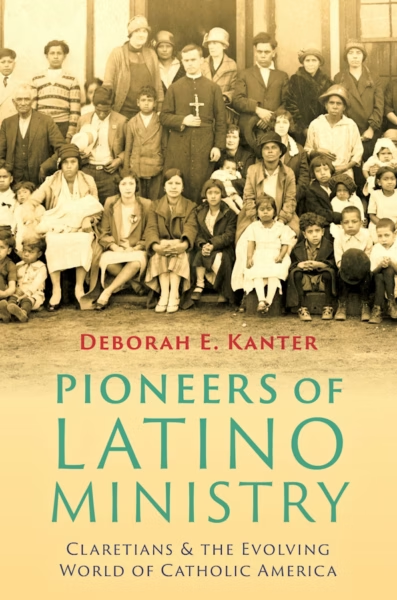 “Pioneers of Latino Ministry tells the story of the Claretian Missionaries, a male Catholic congregation, dedicated to Latin American immigrants and their families on the margins of US society since 1902. The Claretians’ accompaniment of Latinos makes them distinct in American Catholic history. When the first Claretians arrived from Mexico, Spanish speakers were a small, often unrecognized part of Catholic America. Today Latinos constitute half of US Catholics.
Pioneers of Latino Ministry charts the history of the Claretians and their influence on Latino Catholics in the US, as well as on broader American Catholicism. Filled with compelling stories, the volume offers a vital portrait of unexplored Catholic American history.”
P. C. Saidalavi
Seeking Allah’s Hierarchy: Caste, Labor, and Islam in India
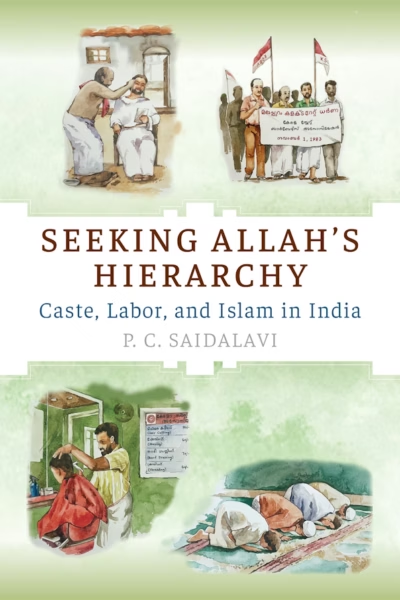 “In Seeking Allah’s Hierarchy, P. C. Saidalavi provides an ethnographic study of a Muslim barber community in South India, unraveling how these barbers negotiated concepts of hierarchy through Islamic values of piety, genealogy, morality, and wealth. Through this close-drawn study, Saidalavi argues that Muslim hierarchy exists and it works on its own terms. It both draws upon Islamic jurisprudential and moral discourses and is shaped by the larger economic, cultural, and political environment, including that of Hinduism. Yet ultimately, Muslim hierarchy is neither a replica nor a watered-down version of caste in Hinduism.
Seeking Allah’s Hierarchy contends that the Islamization process in South Asia cannot be reduced to conceptual schemas or patterns dictating religious practice. Instead, this process works within a “lived tradition,” in which Muslims attempt to infuse and rationalize their practices using their interpretations of Islamic values, meanings, and purpose. In this case, barbers challenged other Muslims’ perception of them as hierarchically inferior by emphasizing their religious piety. Yet those same Muslims also drew on Islam to provide a rationale for categorizing barbers’ work as morally obligatory but undignified, thus rendering the barbers “lower.”
The barbers’ challenge to this perceptual hierarchical order was inspired by communist political activities in Kerala and commenced when they started unionizing in the 1970s. By establishing shops, instituting uniform pricing, and standardizing working hours, barbers successfully transformed their work relations into labor within the strictures of capitalist market relations. Recounting their story here, Saidalavi complicates the question of “caste” found in the Indian subcontinent by showcasing the specificity of hierarchical practices among Muslims, despite the egalitarianism of their religion.”
Jamie Pitts
Organizing Spirit: Pneumatology, Institutions, and Global Imagination
 Contemporary theologians tend to associate the Holy Spirit with the formation of local communities, social movements, and fluid relational networks-and not with institutions such as denominations or global church bodies. In this work, Jamie Pitts argues that this pneumatological-sociological picture misses important aspects of the Spirit’s work.
Pitts draws on a wide range of theological and theoretical resources to depict the Spirit as organizing the complex, dynamic, and relationally entangled structures that constitute creation. Human organizing that seeks to participate in the Spirit can take a variety of analogous structural forms, including formal organizations or institutions. Organizational participation in the Spirit is not a function of an organization’s scale, mobility, or relative informality, but rather of its practical orientation toward the Spirit’s goals of life, solidarity, healing, and inclusive justice. A series of case studies clarifies and extends the implications of the argument in connection to organizing for environmental, gender, sexual, and racial justice. In the final chapter, Pitts addresses the role of a political theology of the organizing Spirit in imagining organizational alternatives to the global neoliberal order.
Huaiyu Chen
Religious Encounters along the Silk Road: Connections, Competitions, and Comparisons
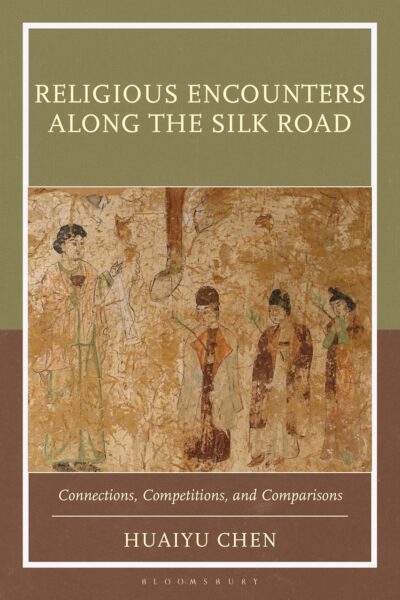 Religious Encounters along the Silk Road draws on a diverse range of sources to examine the connections, rivalries, and interactions among Buddhism, Christianity, and Daoism along the Silk Road during the medieval era.
This book analyzes these dynamics from political, textual, ritual, and ethnic perspectives to argue that interreligious exchanges were integral to the broader process of medieval globalization, shaping political and religious life in Central Asia and China within a multilingual, multi-religious, and multi-ethnic environment. This book further suggests that Buddhists, Christians, and Daoists coexisted within shared political, textual, ritual, and ethnic spheres, developing distinct strategies to navigate and adapt to political and religious challenges. These communities likely influenced one another’s texts and rituals under the same political regime.