

Please join us in celebrating our members on their professional news and accomplishments!
As a reminder, AAR publishes member accomplishments including new publications, award announcements, and media mentions. Share your wins with us!
Awards and Accomplishments
Judith Weisenfeld’s book, Black Religion in the Madhouse: Race and Psychiatry in Slavery’s Wake, Receives 2026 PROSE Award
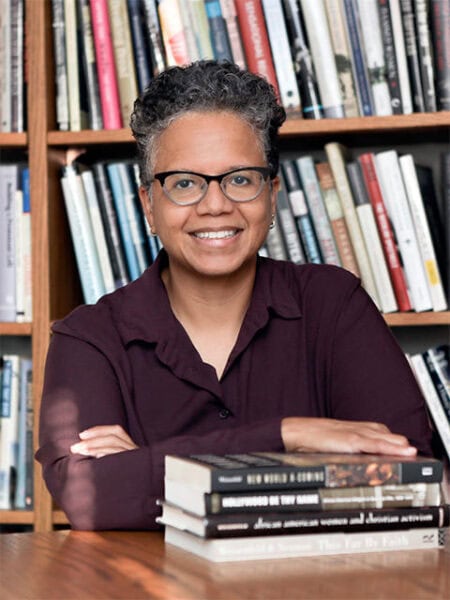
The Association of American Publishers (AAP) unveiled the Finalists and Category Winners for the 50th annual PROSE Awards, honoring professional and scholarly works published in 2025. The PROSE Awards, first presented in 1976, recognize professional and scholarly publishers that have made significant advancements in their respective fields of study each year as judged by a multidisciplinary panel of experts. Judith Weisenfeld’s book, Black Religion in the Madhouse: Race and Psychiatry in Slavery’s Wake, received a 2026 PROSE Award from the Association of American Publishers in the Psychology and Applied Social Work category.
Perry Schmidt-Leukel Wins 2025 Frederick J. Streng Award for Excellence in Buddhist-Christian Studies for his 2024 volume, The Celestial Web: Buddhism and Christianity—A Different Comparison
 The 2025 Frederick J. Streng Award for Excellence in Buddhist-Christian Studies has been given to Perry Schmidt-Leukel for his 2024 volume, The Celestial Web: Buddhism and Christianity—A Different Comparison. Perry Schmidt-Leukel is a Senior Professor of Religious Studies and Intercultural Theology at the University of Münster, Germany. Schmidt-Leukel’s work introduces a methodological approach he refers to as a “fractal” approach to religious diversity, shifting away from a monolithic approach to Buddhist-Christian comparative studies. This work opens up avenues for the comparative study that moves past binaries and will surely have a lasting impact on the advancement of the field.
Books and Publications
Rebecca Carter-Chand
Christian Internationalism and German Belonging: The Salvation Army from Imperial Germany to Nazism

Ever since the Salvation Army, a British Protestant social welfare organization, arrived in Germany in 1886, it has navigated overlapping national and international identities. After existing on the margins of the German religious landscape while solidifying its role as a social service provider, the Salvation Army proactively shaped its public profile during the Nazi rise to power. Accepted into the Nazi Volksgemeinschaft (ethnonational community) and made an auxiliary member of the National Socialist People’s Welfare (NSV), the organization continued limited operations throughout the Nazi period before returning to its international affiliations in the immediate postwar period, thereby bypassing denazification and rehabilitating its reputation.
In this groundbreaking reevaluation, Rebecca Carter-Chand argues that the Salvation Army was able to emphasize different aspects of its identity to bolster and repair its reputation as needed in varied political contexts, highlighting the variability of Nazi practices of inclusion and exclusion. In that way, the organization was similar to other Christian groups in Germany. Counter to common hypotheses that minority religious groups are more likely to show empathy to other minorities, dynamics within Nazi Germany reveal that many religious minorities sought acceptance from the state in an effort to secure self-preservation.
Nareman Amin
Is God for Revolution?: Affect, Youth, and Islam in Post-2011 Egypt
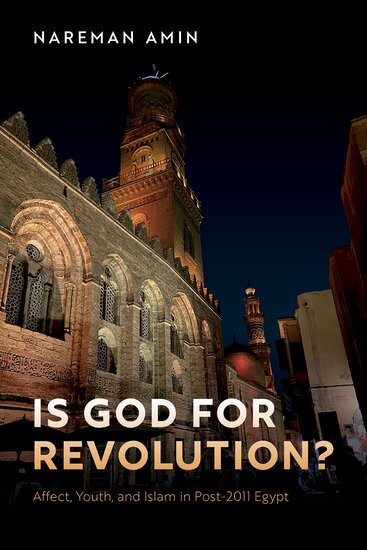 Based on interviews with upper-middle-class Egyptian Muslims, Is God for Revolution? explores the ways in which political participation in the 2011 Egyptian revolution–and the emotions that came with it–changed the landscape of religious discourse and practice. Before the revolution, the interviewees found themselves in structures of culturally agreed-upon forms of religiosity. They were raised during what scholars call the “Islamic Awakening” of the late twentieth century and heeded the advice of religious figures that circulated freely in mass media. Visible markers of piety, such as the veil for women and beards for men, became commonplace. This all changed in one charged moment. In the wake of the uprising, Nareman Amin shows, revolutionary feelings–notably hope, disappointment, doubt, shock and anger-transformed their understandings of what it means to identify as pious Muslims.
Is God for Revolution? is a book about social change in a time of political upheaval and uncertainty, specifically the relationship between affect, politics and Islam. It is a story about postrevolutionary agency, the emotional toll that this democratic experiment had on those who believed in the revolution and its ideals, and the transformative power of autonomy and emotion on young revolutionaries’ attitudes toward religious authorities and religious beliefs and practices.
Christopher Miller and Cogen Bohanec
Engaged Jainism: Critical and Constructive Studies of Jain Social Engagement
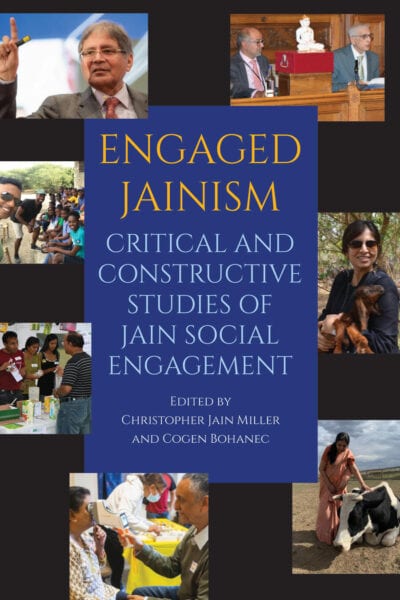 The Jain tradition, with roots in ancient India but now spread across the globe, is anything but static and monolithic. In Engaged Jainism, an interdisciplinary cohort of academics and practitioners explore the manifold ways in which Jains and Jain ideas become engaged in social worlds—historically, philosophically, philologically, and anthropologically. Following the legacy of Engaged Buddhism, the groundbreaking volume edited by Christopher S. Queen and Sallie B. King, this volume shows how Jain traditions become engaged in everyday life, puts Jain ideas in dialogue with Western philosophical traditions, and examines the ways in which Jains have maintained Jain identity in their engagement with other religious traditions and cultural influences in the past and present. Across all of these disciplinary approaches, Jainism emerges as a dynamic, protean, and diverse tradition.
Cass Fisher
Jewish Theological Realism: Recovering Reference to God in Rabbinic and Modern Thought
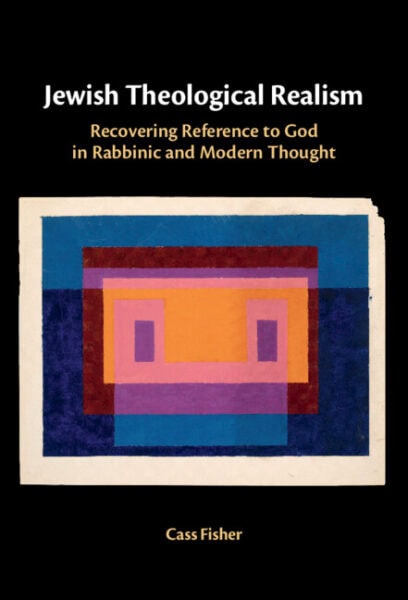 Jewish Theological Realism restores the place of theology in rabbinic Judaism and provides resources for contemporary Jewish theological reflection. Cass Fisher uses the ideas of theological realism and theological reference to diagnose and remedy the marginalization of theology in Judaism. Both the depiction of rabbinic theology as an edifying discourse for the laity, and the pervasive move in modern Jewish thought to limit theological language arise from skepticism about our ability to make truth claims about God. Fisher argues that the rabbis valued knowledge of God and affirmed their capacity to speak truthfully about the divine. Moreover, while most modern Jewish thinkers sharply limit theological language, there exists an important countertrend of theological realists who have sought to preserve Jewish theology. Fisher concludes with the first application of new theories of reference to theology, demonstrating that these approaches to reference can resolve longstanding challenges to Jewish theology and provide the basis for re-envisioning theology as a communal and religious practice.
Emily A. Holmes
Marian Reflections on War and Peace: Trauma, Mourning, and Justice in Ukraine and Beyond
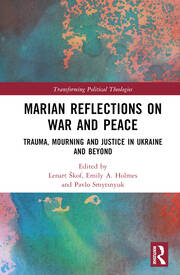 This book presents an original Marian approach towards war and peace, dedicated to the suffering of children, women, and men in Mariupol and elsewhere in Ukraine and in the world. Offering new theological perspectives on the contemporary impact of war, the contributions take inspiration from the figure and symbol of Mary – as protector of children and guardian of peace, intermediary of the incarnation, as well as model for ecumenical, interreligious, and intercultural engagements. The chapters explore the role of Mary as a symbol for feminist and activist reflections, for the communication of suffering as the mater dolorosa, for power when appropriated for political ends, and for healing and reconciliation in peace-building efforts. The book provides readers with valuable theological reflections on conflict, global theological ethics, ecofeminist and peace-building thinking in theology, and contemporary political theology.